
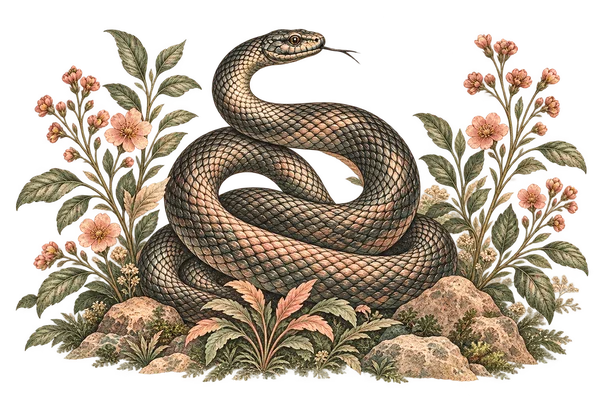
Una serpiente puede evocar cambio, cautela o fascinación. Tu experiencia con las serpientes es el mejor punto de partida.
¿Cuál fue tu versión?
Una serpiente cerca
¿Qué capta tu atención incluso cuando permanece en silencio?
Una serpiente mudando la piel
¿Qué etapa sientes que puedes dejar atrás?
Una mordedura
¿Qué momento te hirió de forma inesperada?
Una forma de pensarlo
Una serpiente aterradora y una hermosa piden lecturas distintas. Anota su distancia, sus movimientos y tu primera reacción. Una serpiente que muda la piel puede convertirse en una imagen personal de una transición; una serpiente oculta puede invitarte a reflexionar sobre la incertidumbre. Son posibilidades que contrastar con tu vida, en lugar de significados que debas aceptar.
Lleva una pregunta a tu día.
Guárdalo antes de que se desvanezca. Sin necesidad de cuenta.
HISTORIAS Y CONTEXTOLas historias detrás del símbolo
Las historias detrás del símbolo
En las imágenes de la antigua Grecia, la vara de Asclepio vincula una serpiente con la curación. La serpiente del jardín bíblico del Edén pertenece a una historia muy distinta sobre la tentación y el conocimiento. Comparar estas tradiciones muestra por qué atribuirle un único significado universal sería engañoso.
Comparar los relatos históricos
Estas son interpretaciones históricas de sus autores. Sus pronósticos y juicios de época se conservan como fuentes, no como predicciones ni significados establecidos para tu sueño.
Gustavus Hindman Miller · Serpents
Ten Thousand Dreams Interpreted; Or, What’s in a Dream · Gutenberg #926; bibliography identifies the 1901 original and subsequent reprints
Serpents · Heading 1809; source lines 20080–20089 · Text transcription
Fuente original (inglés)
To dream of serpents, is indicative of cultivated morbidity and depressed surroundings. There is usually a disappointment after this dream. See Snakes and Reptiles.
Gustavus Hindman Miller · Snakes
Ten Thousand Dreams Interpreted; Or, What’s in a Dream · Gutenberg #926; bibliography identifies the 1901 original and subsequent reprints
Snakes · Heading 1867; source lines 20677–20751 · Text transcription
Fuente original (inglés)
For a woman to dream that a dead snake is biting her, foretells she will suffer from malice of a pretended friend.
To dream of snakes, is a foreboding of evil in its various forms and stages.
To see them wriggling and falling over others, foretells struggles with fortune and remorse.
To kill them, you will feel that you have used every opportunity of advancing your own interests, or respecting that of others. You will enjoy victory over enemies.
To walk over them, you will live in constant fear of sickness, and selfish persons will seek to usurp your place in your companion's life.
If they bite you, you will succumb to evil influences, and enemies will injure your business.
To dream that a common spotted snake approaches you from green herbs, and you quickly step aside as it passes you, and after you had forgotten the incident to again see it approaching and growing in dimensions as it nears you, finally taking on the form of an enormous serpent; if you then, after frantic efforts, succeed in escaping its attack, and altogether lose sight of it, it foretells that you will soon imagine you are being disobeyed and slighted, and things will go on from bad to worse. Sickness, uneasiness and unkindness will increase to frightful proportions in your mind; but they will adjust themselves to a normal basis, and by the putting aside of imaginary trouble, and masterfully shouldering duties, you will be contented and repaid.
To dream that a snake coils itself around you and darts its tongue out at you, is a sign that you will be placed in a position where you will be powerless in the hands of enemies, and you will be attacked with sickness.
To handle them, you will use strategy to aid in overthrowing opposition.
To see hairs turn into snakes, foretells that seeming insignificant incidents will make distressing cares for you.
If snakes turn into unnatural shapes, you will have troubles which will be dispelled if treated with indifference, calmness and will power.
To see or step on snakes while wading or bathing, denotes that there will be trouble where unalloyed pleasure was anticipated.
To see them bite others, foretells that some friend will be injured and criticised by you.
To see little snakes, denotes you will entertain persons with friendly hospitality who will secretly defame you and work to overthrow your growing prospects.
To see children playing with them, is a sign that you will be nonplussed to distinguish your friends from your enemies. For a woman to think a child places one on the back of her head, and she hears the snake's hisses, foretells that she will be persuaded to yield up some possession seemingly for her good, but she will find out later that she has been inveigled into an intrigue in which enemies will tantalize her. To see snakes raising up their heads in a path just behind your friend, denotes that you will discover a conspiracy which has been formed to injure your friend and also yourself. To think your friend has them under control, denotes that some powerful agency will be employed in your favor to ward off evil influences.
For a woman to hypnotize a snake, denotes your rights will be assailed, but you will be protected by law and influential friends. See Serpents and Reptiles.
Felix Fontaine
The Golden Wheel Dream-book and Fortune-teller · 1862
Snake · Heading 737; source line 4601 · Text transcription
Fuente original (inglés)
To dream of snakes is a sign of an enemy, or that some one is slandering you; it also denotes quarrels and angry disputes: if an engaged young lady dreams of them, she had better ascertain positively whether her lover is all right before she marries him.
A. H. Noe · Serpent
The Witches' Dream Book; and Fortune Teller · New York, Henry J. Wehman, 1885
Serpent · Dream section, heading 462; source lines 1695–1700 · Text transcription
Fuente original (inglés)
To dream you see a serpent turning and winding himself, signifies danger and imprisonment. It denotes also sickness and hatred. To dream you kill a serpent, is a sign that you will overcome your enemies. To dream of beating serpents is very good, and if a serpent approaching near to do you harm, but does it not, it is a sign that some ill woman shall be disappointed in her designs.
A. H. Noe · Snakes
The Witches' Dream Book; and Fortune Teller · New York, Henry J. Wehman, 1885
Snakes · Dream section, heading 488; source lines 1795–1799 · Text transcription
Fuente original (inglés)
To dream you see snakes and serpents, shows that you will be imprisoned, and encounter many dangers. If you are in love, your sweetheart will be false; to dream you kill a snake, shows you will overcome difficulties and enemies and be successful in love, trade or farming, but unsuccessful at sea.
Astra Cielo
Fortunes and Dreams · New York, George Sully, 1917
Snake · Dream section, heading 392; source lines 4809–4812 · Text transcription
Fuente original (inglés)
Denotes treason, and is a caution to be careful whom you trust.
Anonymous
Everybody’s Book of Luck · Whitman Publishing Company edition; date not stated in transcription
Snake, Serpent · Dream section, heading 218; source lines 4086–4088 · Text transcription
Fuente original (inglés)
Bad luck, sickness, short life.
Nota de la fuente (inglés)
The source heading “Snake, Serpent” is shown on the Snakes page: book of Luck "Snake, Serpent" heading
Ver la edición de la fuenteAnonymous · Serpents
The Interpretation of Dreams and Moles · United Kingdom, J. Marshall, 1805
Serpents · Dreams interpreted, passage 7; source lines 130–131 · Text transcription
Título original de la fuente: (no printed heading)
Fuente original (inglés)
To dream you are stung or bitten by serpents or insects, denotes mischief to come from malicious and private enemies.
Nota de la fuente (inglés)
The 1805 text prints this passage without a heading; DreamFolia files it under “Serpents” because that is the subject of its first clause.
Ver la edición de la fuenteAnonymous · Serpents
The Interpretation of Dreams and Moles · United Kingdom, J. Marshall, 1805
Serpents · Dreams interpreted, passage 61; source lines 287–288 · Text transcription
Título original de la fuente: (no printed heading)
Fuente original (inglés)
To dream you are bit by a serpent, signifies some danger will befal you by secret and subtile enemies.
Nota de la fuente (inglés)
The 1805 text prints this passage without a heading; DreamFolia files it under “Serpents” because that is the subject of its first clause.
Ver la edición de la fuenteKatherine Taylor Craig · Serpent
The Fabric of Dreams: Dream Lore and Dream Interpretation, Ancient and Modern · New York, E. P. Dutton & Company, 1918; original US edition
Serpent · Printed p. 252; NLM OCR lines 11842–11853 · OCR transcription
Fuente original (inglés)
A dream of temptation and of evil (Gypsy). Obviously the dream interpreters of modern times have accepted the Christian and Jewish symbolism, rather than that of more remote antiquity. Freud and Jung, however, revert to more primitive times and interpret this as an erotic dream. Raphael interprets the serpent dream as one of "a deadly enemy bent on your ruin; to kill one denotes success over your enemy." The serpent was the ancient Egyptian symbol of wisdom and of the sun; curled in a circle it represented time without end; twisted around a staff, it denoted health. "More subtle thou art than any beast of the field" (Bible).
Katherine Taylor Craig · Snake
The Fabric of Dreams: Dream Lore and Dream Interpretation, Ancient and Modern · New York, E. P. Dutton & Company, 1918; original US edition
Snake · Printed p. 254; NLM OCR lines 11964–11965 · OCR transcription
Fuente original (inglés)
See Serpent.
Fuentes de esta página
- Understanding Sleep — general dream context, not a symbol interpretation
National Institute of Neurological Disorders and Stroke
Nota de la fuente (inglés)
General background: waking experiences and emotion can enter dreams; the function of dreaming is not settled. Does not test or validate this entry’s symbolic reflections.
También se encuentra como: serpiente · culebra · culebras · snake · snakes · serpent · serpents · snake, serpent
A little more to explore.
- Snake dreams: compare the encounter before choosing a meaning
Explore snake dreams through bites, pursuit, hidden snakes, and calm encounters, with an original worked example and questions grounded in your scene.
- Dream symbols and personal meaning: start with your associations
Explore dream symbols through the scene, your associations, and several possible readings. Use a dictionary to ask better questions about your own experience.
- Freud and Jung on dreams: two historical approaches
Compare Freud’s dream-work with Jung’s attention to context and symbolic narrative. Read their ideas as historical theories, with clear limits.
Original reflection with AI-assisted editorial review on 2026-10-15, following the site owner’s delegation of editorial decisions. Historical forecasts remain attributed period claims; these reflections are not predictions or clinical assessments. Actualizado el 2026-10-15. Lee nuestro enfoque y las fuentes.