
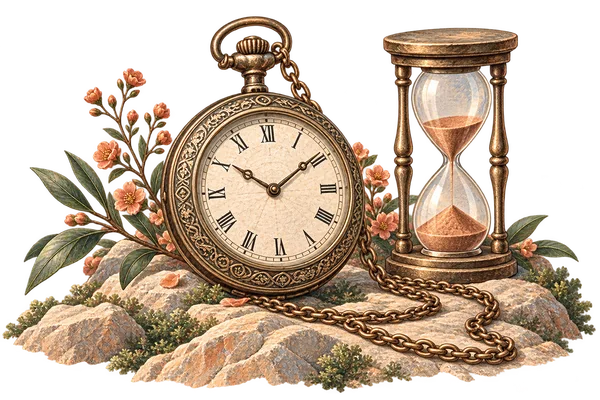
A clock can suggest pressure, waiting, or difficulty matching your pace to shared expectations. Stopped time can feel restrictive or welcome.
What this dream can mean
The available time does not match the task
A racing clock can picture demands advancing faster than preparation. The pressure becomes concrete through the gap between how quickly time passes and what you need before proceeding.
Waiting or being allowed to pause
Stopped time can suggest progress depending on another person, but may also offer wanted relief. Your wish for the hands to move or remain still changes the reading.
Conflicting schedules and returning demands
Disagreeing clocks can picture expectations that cannot share one pace. Repeated alarms may bring an unfinished task or recurring interruption into view, especially when responding does not end it.
Which version was yours?
The hands move too fast to follow
This can picture a change or deadline outpacing your ability to prepare. A rapidly expanding role or crowded period may fit. The clock makes adjustment time feel unavailable, even when you understand the task and want to meet it.
The clock stops while you wait for news
A stalled clock can express how waiting makes ordinary effort feel unable to change the situation. An application, decision, or delayed response may offer a parallel. The scene centers dependence on an outcome whose timing you cannot personally accelerate.
Every clock shows a different time
Conflicting measures can picture responsibilities operating to incompatible schedules. Work may demand urgency while a family change needs patience. The difficulty is deciding which expectation governs your next action, rather than finding one objectively correct pace for every part of life.
An alarm sounds again whenever you silence it
This can suggest an interruption that returns despite repeated attention. Unfinished messages, recurring tasks, or demands without a clear endpoint may fit. Responding provides temporary relief, while the repeated sound makes the need for a more lasting arrangement visible.
You turn the hands backward
Changing the clock can picture wanting another chance to prepare, reconsider, or remain in a familiar period. A choice made quickly or a transition that seems too final may fit. The wish concerns the opportunity more time would provide, rather than time itself.
Time stops and you enjoy the quiet
A welcome pause can suggest relief from proving you can keep pace. Rest after sustained responsibility or a wish for unmeasured time may offer a parallel. Because the stillness feels good, stopping becomes permission rather than a picture of blocked progress.
A way to think about it
A clock can picture the gap between the time available and what you need to do within it. Hands moving too quickly may fit a deadline approaching faster than your preparation, or a period whose changes leave little room to adjust. The image makes pressure visible through speed rather than simply declaring that you are anxious.
A clock that will not move can express waiting without useful progress. A decision, message, or stage of a project may depend on someone else, leaving you unable to turn effort into a result. But stopped time can also offer relief: a pause in which demands no longer advance. Whether you want movement distinguishes stalled progress from wanted rest.
Different clocks showing different times can picture conflicting expectations. Work, family, and personal priorities may each impose a schedule, with no single pace satisfying them all. A clock you cannot read can instead suggest uncertainty about what timing is expected. The difficulty is not necessarily lateness; it may be that the terms of being ready are unclear.
An alarm or striking clock can give form to a demand for attention. A task you have deferred, an approaching meeting, or a remembered routine may intrude into the scene. Being able to silence the sound may express choice over that demand, while repeated alarms can picture interruptions that keep returning after you respond.
Turning a clock backward may suggest wanting more preparation, revisiting an earlier choice, or resisting a change that feels too final. Real alarms, watches, appointments, and travel schedules can also supply the image directly. The particular relationship between your needs and the clock's pace provides the basis for these original interpretations.
Take a question into your day.
Save it before it slips away. No account needed.
STORIES & CONTEXTThe stories behind the symbol
The stories behind the symbol
Miller's Clock entry makes seeing or hearing a clock an adverse omen. Fontaine's 1862 passage gives a striking clock a marriage forecast, while assigning other fortunes to damage and different hours of the day.
Their disagreement shows that the sound itself did not have one settled historical meaning. The useful modern question concerns what the clock organizes or interrupts in the dream. A deadline, a wait, or a welcome pause can each involve time without adopting the books' forecasts about future events.
Compare the historical accounts
These are the authors’ historical interpretations. Their forecasts and period judgments are preserved as source material, not as predictions or established meanings for your dream.
Gustavus Hindman Miller
Ten Thousand Dreams Interpreted; Or, What’s in a Dream · Gutenberg #926; bibliography identifies the 1901 original and subsequent reprints
Clock · Heading 436; source lines 5754–5760 · Text transcription
Original source (English)
To dream that you see a clock, denotes danger from a foe. To hear one strike, you will receive unpleasant news. The death of some friend is implied.
Felix Fontaine
The Golden Wheel Dream-book and Fortune-teller · 1862
Clock · Heading 147; source line 1583 · Text transcription
Original source (English)
To dream you hear the clock strike, denotes speedy marriage; if you dream the clock falls or breaks, it denotes danger. To dream of counting the hours of the forenoon, is lucky; the afternoon, unlucky.
Artemidorus; English translation attributed to Robert Wood
The Interpretation of Dreams · 1644; EEBO-TCP A25906 transcription
Of the Clock. · Book 3, encoded section 169 · Text transcription
Original source (English)
A Clock signifieth actions, operations, motions, attempts, and surprizing in any necessary things: if the clock fall or breake, it is ill and great danger, especially to the sick: it is ever better to count the houres before noone then after.
A. H. Noe
The Witches' Dream Book; and Fortune Teller · New York, Henry J. Wehman, 1885
Clock · Dream section, heading 83; source lines 425–431 · Text transcription
Original source (English)
To dream you hear the clock strike, denotes that you will be speedily married, and that you will be moderately successful in life. To dream you are counting the hours, if in the forenoon, shows much happiness, and that your sweetheart is true to you, but if in the afternoon, that misfortune and danger will attend you, and that your sweetheart is false and loves another.
Astra Cielo
Fortunes and Dreams · New York, George Sully, 1917
Clock · Dream section, heading 109; source lines 4121–4123 · Text transcription
Original source (English)
Seeing or hearing a clock denotes marriage.
Sources for this page
- Understanding Sleep — general dream context, not a symbol interpretation
National Institute of Neurological Disorders and Stroke
General background: waking experiences and emotion can enter dreams; the function of dreaming is not settled. Does not test or validate this entry’s symbolic reflections.
Also indexed as: of the clock · clocks · clock striking · stopped clock · clock face · alarm clock
Original DreamFolia editorial expansion with image-specific interpretations and six differentiated scenes. Historical context is attributed to actual source passages. Human publication review pending. Updated 2026-10-13. Read our approach and sources.