
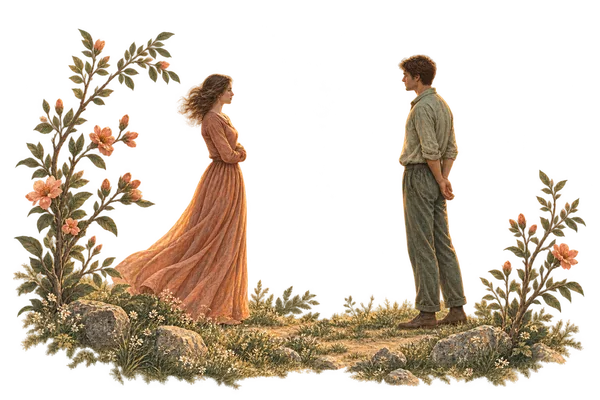
A crush dream may explore anticipation, imagined attention or an admired quality without revealing the real person’s interest in you.
What this dream can mean
Anticipated openings
An approach, an interruption or an unused chance can help you describe what you hoped to say. The dreamed encounter is not a forecast or a test of social ability.
Admiration with personal detail
What you notice about the person can include attraction and a valued quality together. A broader association need not replace your literal interest or claim to explain it completely.
An imagined version of someone
Differences from real contact show where the dream invented information. Record those differences without treating them as insight into the person’s true feelings or character.
Which version was yours?
They begin a conversation you had hoped for
The person asks about an interest you would like to share. This might let you experience a particular kind of welcome attention. Describe what makes the conversation enjoyable and which details are invented; the dream supplies no evidence that the real person plans to approach you.
You rehearse a sentence but use different words
You prepare what to say, then the encounter leads in another direction. The scene could focus on flexibility rather than completing a perfect introduction. Notice whether the change feels relieving, awkward or interesting, without treating the dream as a rehearsal that predicts a real conversation.
A friend announces your interest for you
Someone labels the crush before you have chosen how to speak about it. This may bring privacy and authorship into focus within the imagined encounter. Record what you want to clarify or keep private; the scene does not establish that your real friend would disclose anything.
The person knows something you never told them
Your crush refers to a private detail that belongs only to your own experience. This may show how the dream combines your information with an imagined character. Notice what the knowledge changes in the scene rather than reading it as evidence of a special connection or actual understanding.
An admired quality appears in another person
The crush’s voice, humor or way of listening continues even as their appearance changes. The scene might help you name a quality you enjoyed in the exchange. It need not mean the original person was merely a symbol or prove that your waking attraction has shifted.
You decide not to pursue the opening
An opportunity to talk arrives, but you choose another activity or companion. This could give changing interest, timing or preference a place in your reflection. Record why the choice fits the dream, without making it an instruction to abandon or act on the crush in waking life.
A way to think about it
Dreaming about a crush may create an encounter you have anticipated, a conversation you have never imagined or a familiar person behaving unexpectedly. Start with what happened between you and how it differed from your actual contact. The dream cannot tell you whether that person is interested in you. A pleasant exchange is an experience to describe, while an awkward one does not forecast a failed meeting.
Consider what makes this person noticeable to you. Attraction, humor, a shared interest, kindness or the frequency of seeing them may provide different material. An admired quality might be useful to reflect on without reducing the person to a symbol. For example, an easy conversation in the dream could bring attention to the kind of exchange you enjoy, whether or not that exchange has occurred with them in waking life.
Anticipation can shape the scene through openings and obstacles. You may rehearse a sentence, find an unexpected chance to talk or realize you no longer want the conversation you planned. This could help you describe uncertainty about what you want to say or the conditions in which you would prefer to meet. The dream is not a test of confidence. Waiting, approaching and choosing not to approach all leave different questions open.
The imagined person may know information they could not have, respond with an unfamiliar voice or appear in a place where you would never encounter them. Mark those invented details rather than treating them as revelations. If a scene changes how you feel about the crush, explore the particular moment of change without concluding that the dream has discovered their true character or your hidden intentions.
Attention from others can also alter the exchange. A friend watching, an introduction that labels your interest or a conversation suddenly becoming public may put presentation ahead of connection. Notice what remains yours to express. Waking experiences and emotions can enter dreams, including recent contact, repeated thoughts and media scenes. You can enjoy a fantasy, describe uncertainty or leave the experience unresolved. Reflection does not require contacting the person or deciding that a dreamed action proves whom you should want.
Take a question into your day.
Save it before it slips away. No account needed.
STORIES & CONTEXTThe stories behind the symbol
The stories behind the symbol
No historical account is attached to this specific crush topic. The reflection concerns attraction or admiration toward a person, rather than the physical action of crushing something. The general sleep source supports only the possibility that waking experiences and emotions can enter dreams. It cannot validate these original readings or establish what the real person feels, intends or would do.
Sources for this page
- Understanding Sleep — general dream context, not a symbol interpretation
National Institute of Neurological Disorders and Stroke
General background: waking experiences and emotion can enter dreams; the function of dreaming is not settled. Does not test or validate this entry’s symbolic reflections.
Also indexed as: a crush · my crush · dreaming about my crush · crush dream · having a crush · secret crush · dreaming of a crush · crush kissing me
Original reflections for personal exploration. Sources are identified on this page. Human publication review is pending. Updated 2026-10-14. Read our approach and sources.