
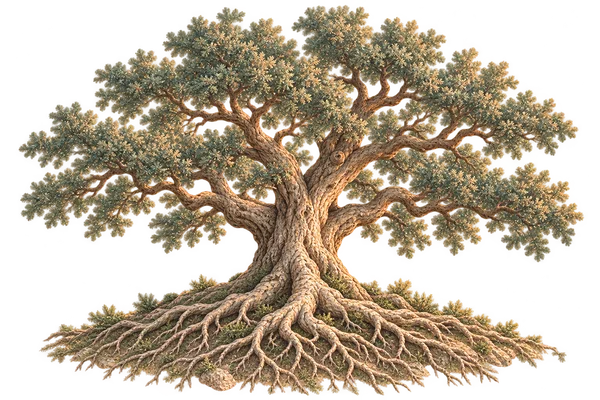
A forest can suggest uncertainty about direction, a wish for shelter, or space away from demands. Being lost differs from choosing to wander.
What this dream can mean
Seeing details without seeing the route
Repeated trees and concealed turns can picture uncertainty about priorities or a destination. The obstacle is limited perspective, especially when you need to arrive somewhere rather than wander freely.
Privacy or unwanted distance
The canopy can suggest shelter from demands, while separation can make connection difficult. Chosen solitude and being unable to find someone create different experiences within the same landscape.
A familiar path no longer guides you
An overgrown route can picture an approach that once worked but now requires reconsideration. A marked path or helpful companion may instead make an unfamiliar situation feel navigable.
Which version was yours?
Every direction looks like the same trees
This can picture comparing options without a clear way to tell them apart. Conflicting priorities, repetitive tasks, or uncertain instructions may offer parallels. Movement alone does not resolve the problem because the scene withholds the landmarks that would make progress recognizable.
You walk peacefully on a sunlit path
A clear route through a sheltered place can suggest having enough guidance without needing to control everything ahead. It may fit a manageable transition or wanted time away from demands. The pleasure makes chosen solitude more central than fear of getting lost.
You reach a clearing but feel exposed
Greater visibility does not always bring comfort. This may picture making a private concern public or leaving the protection of a familiar role. The clearing offers perspective, but also removes the cover that helped you feel secure while moving through uncertainty.
You return to woods from childhood
A remembered landscape can connect present choices with an earlier sense of freedom, danger, or belonging. Missing companions may make change more visible than the trees themselves. The scene can be a direct return to memory rather than an abstract encounter with the unknown.
A path you know has become overgrown
This can picture relying on a familiar approach that no longer provides straightforward passage. An old routine, friendship pattern, or professional method may now require adjustment. The route still exists, but reaching its destination calls for more than repeating the previous journey.
Your group takes another route and you remain behind
A separation of paths can express differing priorities rather than simple abandonment. You may want to stay with others while needing a different pace or destination. The scene can hold the difficulty of choosing your own direction without losing valued company.
A way to think about it
A forest can picture a situation in which you see what is immediately around you but not the whole arrangement. Similar trees, concealed turns, and a path that disappears can fit work with unclear priorities or a change whose destination remains difficult to judge. Being lost gives this limited view an urgent quality; wandering by choice may instead express curiosity without a need for a fixed outcome.
Trees can also make the forest feel protective. A quiet walk beneath a canopy may fit wanting distance from scrutiny, noise, or constant demands. Solitude can be restorative when you choose it, while the same distance can feel isolating if you are trying to find someone. The distinction is between shelter from interruption and separation from contact you want.
A path can represent the amount of guidance available. A marked route may support trust in a process, while an overgrown path can suggest that an old way no longer fits present conditions. Following another person may bring dependence or companionship into view. Their presence matters through what you are able to do together, not through a fixed claim about what they symbolize.
A clearing changes the balance between concealment and exposure. Reaching open space can make orientation possible, or leave you feeling visible without protection. This may fit leaving a familiar group, making a private concern public, or gaining perspective after being occupied with details.
The forest's familiarity can carry a particular memory: childhood play, a place you walked, or a story whose atmosphere stayed with you. These direct associations may explain more than a metaphor. An original reading becomes useful when the dream's experience of orientation, company, or shelter resembles something specific in your life.
Take a question into your day.
Save it before it slips away. No account needed.
STORIES & CONTEXTThe stories behind the symbol
The stories behind the symbol
Miller's Forest passage gives dense woods and hunger adverse forecasts but reads flourishing trees favorably. It also includes a dream-and-event anecdote offered as confirmation. Noe's 1885 Forest entry reduces walking in a forest to trouble.
These are historical fortune-telling claims, including an anecdote rather than a demonstration. Their useful distinction is between difficult passage and a flourishing landscape. The modern interpretation keeps orientation and atmosphere separate: a dense forest can offer wanted privacy, and an open clearing can feel exposed.
Compare the historical accounts
These are the authors’ historical interpretations. Their forecasts and period judgments are preserved as source material, not as predictions or established meanings for your dream.
Gustavus Hindman Miller
Ten Thousand Dreams Interpreted; Or, What’s in a Dream · Gutenberg #926; bibliography identifies the 1901 original and subsequent reprints
Forest · Heading 824; source lines 9588–9606 · Text transcription
Original source (English)
To dream that you find yourself in a dense forest, denotes loss in trade, unhappy home influences and quarrels among families. If you are cold and feel hungry, you will be forced to make a long journey to settle some unpleasant affair.
To see a forest of stately trees in foliage, denotes prosperity and pleasures. To literary people, this dream foretells fame and much appreciation from the public. A young lady relates the following dream and its fulfilment: “I was in a strange forest of what appeared to be cocoanut trees, with red and yellow berries growing on them. The ground was covered with blasted leaves, and I could hear them crackle under my feet as I wandered about lost. The next afternoon I received a telegram announcing the death of a dear cousin.”
A. H. Noe
The Witches' Dream Book; and Fortune Teller · New York, Henry J. Wehman, 1885
Forest · Dream section, heading 181; source lines 769–770 · Text transcription
Original source (English)
To dream that you are walking in a forest, signifies trouble.
Anonymous
Everybody’s Book of Luck · Whitman Publishing Company edition; date not stated in transcription
Forest · Dream section, heading 87; source lines 3727–3729 · Text transcription
Original source (English)
Trouble and losses through rivals.
Katherine Taylor Craig
The Fabric of Dreams: Dream Lore and Dream Interpretation, Ancient and Modern · New York, E. P. Dutton & Company, 1918; original US edition
Forest · Printed p. 218; NLM OCR lines 10047–10050 · OCR transcription
Original source (English)
A dream of dire trouble and sorrow (Artemidorus). The legends that people the forests with witches, ogres and giants account for this interpretation.
Sources for this page
- Understanding Sleep — general dream context, not a symbol interpretation
National Institute of Neurological Disorders and Stroke
General background: waking experiences and emotion can enter dreams; the function of dreaming is not settled. Does not test or validate this entry’s symbolic reflections.
Also indexed as: forests · woods · woodland · lost in the woods · dark forest
A little more to explore.
- Being lost in a dream: unfamiliar streets, changing maps, and finding a landmark
Compare dreams of being lost through destinations, guidance and small landmarks, with an original route exercise and examples of changing direction.
Original DreamFolia editorial expansion with image-specific interpretations and six differentiated scenes. Historical context is attributed to actual source passages. Human publication review pending. Updated 2026-10-13. Read our approach and sources.