
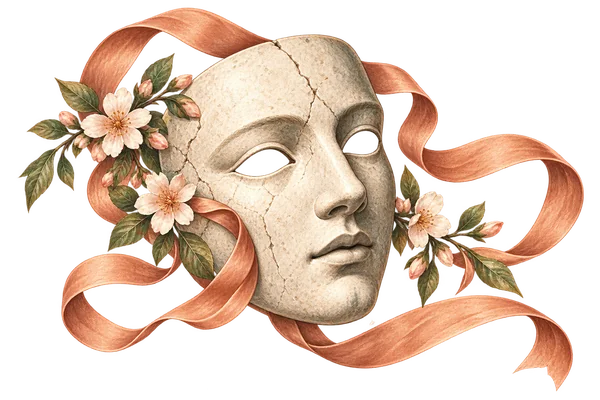
A mask may explore chosen presentation, expression that stays fixed or the terms of putting a role aside. Its purpose need not be concealment or deceit.
What this dream can mean
A role tried by choice
A removable form can support an unfamiliar activity without requiring it to define every encounter. The scene can explore experimenting with presentation while retaining a practical way to put the role aside.
Expression that cannot change
A fixed mask may leave a contribution difficult to communicate. The encounter can become more useful when words, adjustment or another form of attention supplies what the surface cannot show.
Terms of changing or removing the form
Fit, permission and assistance can make removal a chosen transition. Taking the object off differs from being recognized outside its role, so both the physical and shared terms may need attention.
Which version was yours?
A smiling mask stays fixed while you explain a concern
The appearance does not change with the contribution you are trying to make. Another form of communication or attention may help the encounter become fuller. The scene can explore an expected presentation without making the mismatch proof that you or another person is dishonest.
A mask lets you try an unfamiliar performance
The form gives you a chosen way to enter an activity that might otherwise feel too exposed. Keeping the option to remove it may make experimentation useful. The scene’s meaning depends on participation and choice rather than assuming the performance hides a private truth.
The mask fits but needs another person’s help to release
Removal becomes a practical task with terms of assistance. Asking, pausing or explaining what should happen can preserve your say in the transition. The encounter differs when the helper waits for agreement instead of treating the object’s fit as permission to continue.
Everyone knows the masks are part of the gathering
The shared arrangement allows names, movement and conversation to support recognition alongside appearance. This may explore a role that is understood openly. The masks need not imply deceit when their purpose and the participants’ ways of relating are part of the encounter.
Someone changes your mask midway through the scene
An appearance you had chosen becomes another person’s decision. Clarifying, restoring or accepting a limited change can give the encounter different terms. The practical question is how the role remains yours to participate in, rather than whether one expression is inherently correct.
You remove the mask but are still addressed through its role
The object has been put aside while a shared expectation continues. Explaining the change or taking part differently may make the transition more visible. The scene can explore how a role ends without assuming its outward sign was the only thing sustaining it.
A way to think about it
A mask can give an encounter a presentation that remains separate from the face underneath. It may make a role easier to try, hold one expression in place or change how others recognize you. The dream may explore how a chosen form supports participation and where it becomes limiting. A mask used openly in a shared performance creates another scene from one imposed without a chance to decide its terms.
A fixed expression can make communication awkward. A smiling mask may remain unchanged while you try to explain a concern, leaving the appearance and the contribution difficult to connect. This can resemble a role expected to stay reassuring regardless of the task. Speaking in another way, altering the mask or receiving attention beyond its surface can make the encounter more particular without treating a visible mismatch as proof of deception.
Trying a role can also be welcome. A costume or performance mask may let you enter an unfamiliar activity at a chosen distance from your ordinary presentation. A waking comparison could be rehearsing a way of speaking or experimenting with a project before deciding how much to claim publicly. Being able to remove the form can make that trial useful rather than turning it into an assignment that must continue indefinitely.
Fit and removal introduce practical terms. A mask that slips, restricts a view or needs help to release may require a specific adjustment before participation becomes comfortable. Requested assistance differs from another person changing it without asking. The scene can give choice a physical place without making every covering a sign that the wearer is hiding a private truth.
Other people may continue addressing the mask's role after you have put it down. Clarifying the transition can become as important as removing the object. At a gathering where everyone knows that masks are being worn, identity may be understood through names, movement and conversation as well. Recent costumes, equipment, art or stories can supply direct associations. The dreamed mask does not disclose actual dishonesty or a real person's intentions; its action and agreement give it context.
Take a question into your day.
Save it before it slips away. No account needed.
STORIES & CONTEXTThe stories behind the symbol
The stories behind the symbol
Miller, Fontaine and Cielo frequently connect masks with misunderstanding, hypocrisy or infidelity. Craig’s Mask or Masquerade passage instead concerns attending an event and gives it a deceptive-pleasure forecast. Those are attributed period judgments, not evidence that a covering or performance reveals deceit in waking life.
Compare the historical accounts
These are the authors’ historical interpretations. Their forecasts and period judgments are preserved as source material, not as predictions or established meanings for your dream.
Gustavus Hindman Miller
Ten Thousand Dreams Interpreted; Or, What’s in a Dream · Gutenberg #926; bibliography identifies the 1901 original and subsequent reprints
Mask · Heading 1273; source lines 14755–14773 · Text transcription
Original source (English)
To dream that you are wearing a mask, denotes temporary trouble, as your conduct towards some dear one will be misinterpreted, and your endeavors to aid that one will be misunderstood, but you will profit by the temporary estrangements.
To see others masking, denotes that you will combat falsehood and envy.
To see a mask in your dreams, denotes some person will be unfaithful to you, and your affairs will suffer also. For a young woman to dream that she wears a mask, foretells she will endeavor to impose upon some friendly person.
If she unmasks, or sees others doing so, she will fail to gain the admiration sought for. She should demean herself modestly after this dream.
Felix Fontaine
The Golden Wheel Dream-book and Fortune-teller · 1862
Mask · Heading 454; source line 3101 · Text transcription
Original source (English)
To dream you see a person wearing a mask, is a sign of hypocrisy; to the lover, it shows that his sweetheart loves some one better than himself; to a girl, it signifies that her lover is engaged to another. To married people, it portends infidelity to the wedding-ring.
Astra Cielo
Fortunes and Dreams · New York, George Sully, 1917
Mask · Dream section, heading 265; source lines 4497–4500 · Text transcription
Original source (English)
To wear a mask or see someone else wear one indicates hypocrisy.
Katherine Taylor Craig
The Fabric of Dreams: Dream Lore and Dream Interpretation, Ancient and Modern · New York, E. P. Dutton & Company, 1918; original US edition
Mask or Masquerade · Printed p. 233; NLM OCR lines 10836–10838 · OCR transcription
Original source heading: Mask or Masquerade
Original source (English)
To attend one is a dream of deceptive pleasure (Gypsy).
The source heading “Mask or Masquerade” is shown on the Mask page: craig combined heading; masquerade entry stays separate
View source editionAlso indexed as: mask or masquerade
Original DreamFolia reflection independently reviewed for content and source scope. Historical accounts remain attributed period writing. Human publication review pending. Updated 2026-10-13. Read our approach and sources.