
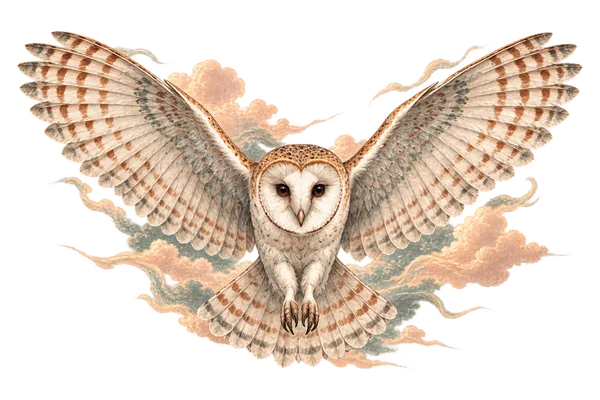
An owl can explore being observed, trying to locate an unclear sound, or revising an encounter shaped by an expectation.
What this dream can mean
An unreadable audience
Being watched can bring contact or a wish for privacy while leaving another person’s response unknown.
Finding the particular source
Locating an unclear sound can replace anticipation with information about what actually needs attention.
An expectation meets action
A familiar image can become another encounter when its setting or behavior changes.
Which version was yours?
An owl watches quietly from across the room
You are visible while the observer’s response remains unclear. This may picture presenting yourself without receiving enough feedback. Moving closer and wanting privacy give the encounter different directions; the owl’s gaze cannot establish what a real audience thinks about you.
An owl call comes from somewhere beyond a wall
Attention is caught by something you cannot yet locate. This can resemble an incomplete request or overheard concern. Finding where the sound belongs may make response possible, without assuming that the call contains a warning about illness, death or another person.
A lamp reveals the room but does not explain the owl’s presence
More surroundings become clear while the central question remains. This may picture gaining facts without understanding your role. A useful explanation differs from additional visibility; the scene does not make darkness threatening or light a guarantee of understanding.
An owl appears during an ordinary daytime errand
A surprising visitor changes the terms of a familiar routine. This can fit an interest or encounter outside its expected setting. Curiosity and inconvenience create different readings, without requiring the animal to symbolize wisdom or a hidden message.
An owl from a book behaves differently from its illustration
An inherited image meets an encounter it cannot fully describe. This may picture a learned expectation becoming too narrow for what is happening now. Revising the account can leave the earlier association useful without insisting that the living scene reproduce it.
The watching owl steps down and crosses your path
Observation becomes a practical question of sharing space. This can resemble an audience turning into a participant in an ordinary task. Making room or waiting changes the encounter more directly than continuing to interpret the visitor solely through its earlier gaze.
A way to think about it
An owl watching from the far side of a room can picture an audience whose response remains difficult to read. You may feel noticed without knowing whether anything is expected. Presenting work to a quiet group or entering an unfamiliar household can offer parallels. Moving closer may make contact possible, while wanting the owl to look away can make privacy the more important need. Its gaze does not reveal someone else’s judgment.
Hearing an owl beyond a wall can turn an indistinct concern into a question of location. A sound interrupts what you are doing, but you cannot yet identify where to respond. This may fit an unanswered request, a conversation overheard incompletely or a task that keeps drawing attention without enough information. Discovering the source changes the encounter from anticipating an unknown demand to meeting something particular.
An owl in a dark room can make the urge to understand visible. Turning on a lamp may reveal the surroundings without explaining why the visitor is there. You might recognize having more facts about a situation while still lacking an account of your role. If darkness feels comfortable, illumination can instead be an interruption of a quiet encounter you wanted to preserve. Neither setting gives the bird a fixed threatening or wise character.
An owl appearing during an ordinary daytime errand can challenge an expectation about where an image belongs. The surprise may resemble an unfamiliar interest entering a routine, or a person being encountered outside their established role. An imagined owl from a book can carry an association with study or a story, but the dream may let that association change when the creature acts differently from the picture.
A motionless owl stepping down to cross your path makes observation become action. You may have organized the scene around being watched and now need to share space with a moving visitor. That shift can fit a relationship whose practical terms become clearer through an ordinary task. A recent picture, remembered call or personal experience can also explain the image directly. The readings depend on the encounter you remember rather than a species-based code.
Take a question into your day.
Save it before it slips away. No account needed.
STORIES & CONTEXTThe stories behind the symbol
The stories behind the symbol
Miller and Noe give adverse health, death, enemy and other forecasts; Fontaine distinguishes a roosting owl from one flying through secret-related claims, while Cielo also predicts revelations. Craig reports several omens and attributed cultural associations. These five passages establish what those books said, not a reliable warning, a medical sign or a universal wisdom symbol.
Compare the historical accounts
These are the authors’ historical interpretations. Their forecasts and period judgments are preserved as source material, not as predictions or established meanings for your dream.
Gustavus Hindman Miller
Ten Thousand Dreams Interpreted; Or, What’s in a Dream · Gutenberg #926; bibliography identifies the 1901 original and subsequent reprints
Owl · Heading 1457; source lines 16550–16562 · Text transcription
Original source (English)
To hear the solemn, unearthly sound of the muffled voice of the owl, warns dreamers that death creeps closely in the wake of health and joy. Precaution should be taken that life is not ruthlessly exposed to his unyielding grasp. Bad tidings of the absent will surely follow this dream.
To see a dead owl, denotes a narrow escape from desperate illness or death.
To see an owl, foretells that you will be secretly maligned and be in danger from enemies.
Felix Fontaine
The Golden Wheel Dream-book and Fortune-teller · 1862
Owl · Heading 535; source line 3516 · Text transcription
Original source (English)
To dream of seeing one of these birds of night in a roosting position, is a sign that you will discover an important secret that relates to yourself: to see an owl flying foretells that some secret of your own will get out.
A. H. Noe
The Witches' Dream Book; and Fortune Teller · New York, Henry J. Wehman, 1885
Owl · Dream section, heading 374; source lines 1442–1444 · Text transcription
Original source (English)
To dream of this bird at night is a bad omen. It foretells sickness, poverty and imprisonment. It also forewarns you some male friend is perfidious.
Astra Cielo
Fortunes and Dreams · New York, George Sully, 1917
Owl · Dream section, heading 300; source lines 4582–4585 · Text transcription
Original source (English)
To dream of an owl means that important secrets will be revealed.
Katherine Taylor Craig
The Fabric of Dreams: Dream Lore and Dream Interpretation, Ancient and Modern · New York, E. P. Dutton & Company, 1918; original US edition
Owl · Printed p. 240; NLM OCR lines 11197–11201 · OCR transcription
Original source (English)
Unhappiness, sickness, discontent; the hooting of an owl in a dream denotes death (Gypsy). The Romans regarded the owl as the bird of wisdom, yet it was an evil portent; in Christian art they symbolize mourning and desolation.
Original DreamFolia reflection independently reviewed for content and source scope. Historical accounts remain attributed period writing. Human publication review pending. Updated 2026-10-13. Read our approach and sources.