
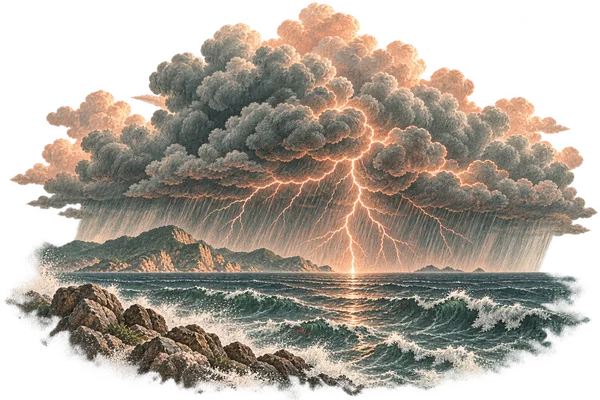
Storm dreams can center disruption, intensity, or shared shelter. Notice what the weather changes and which actions remain possible.
Which version was yours?
You watch lightning from a secure room
The boundary may let you experience awe as well as caution. Notice whether the room feels dependable and whether anyone shares your view. A question about intensity at a comfortable distance may fit better than one about conflict.
You search for shelter while wind blocks your path
Describe the practical obstacle and the places you consider safe. Does someone help you find a route, or do you improvise? The scene can explore navigating disruption without proving that you lack support in your waking circumstances.
You return outside after the storm passes
Clearing weather may reveal relief, damage, or an unchanged landscape. What do you inspect first, and what can wait? The aftermath may offer a question about recovery or simply reflect a familiar routine after real bad weather.
A way to think about it
A storm is made of separate details: wind, rain, thunder, lightning, darkness, and changes in the landscape. Name the one that shaped your experience most. Watching a storm approach differs from being caught in it or discovering damage afterward. Were you traveling, protecting a place, waiting with others, or enjoying the force from a secure room?
The scene may offer a comparison with an intense disagreement or unpredictable period if that fits your life. Be precise about the resemblance rather than calling all stormy weather inner conflict. Loud noise could center interruption, wind could make movement difficult, and darkness could limit what you can see. A recent weather event, film, forecast, or remembered night can be direct context as well.
Shelter makes the dream's resources visible. A sturdy room, a shared umbrella, a damaged roof, or no accessible building creates a different balance between exposure and support. Notice whether you choose the shelter, whether someone welcomes you, and whether you can help another person. The dream's conditions do not prove that you are unprotected while awake; they describe what safety looked like within this scene.
The end can be as specific as the storm itself. Clearing skies may feel reassuring or reveal work that remains. A storm that passes without damage may leave you wondering why you were afraid; one that you watch with fascination may hold excitement rather than distress. Include these differences. An intense landscape does not require a dramatic explanation or establish that an upheaval is about to occur.
Take a question into your day.
Save it before it slips away. No account needed.
STORIES & CONTEXTThe stories behind the symbol
The stories behind the symbol
Miller's Storm entry gives an unfavorable forecast to an approaching storm and softens it if the storm passes. Fontaine's 1862 Storm passage also connects devastating weather with trouble, while distinguishing violent rain from gentle showers and mixing favorable and unfavorable outcomes. These are supplied examples of period fortune-telling organized around severity and duration.
The passages document a habit of mapping difficult weather onto difficult fortunes, not a reliable link between dreams and events. A sheltered observer, a worker caught outdoors, and someone excited by lightning can have very different experiences that the short forecasts cannot capture. This entry's original contextual comparison asks what the weather interrupted, which resources were available, and how the scene changed afterward. A passing storm need not promise resolution, and a continuing storm need not announce trouble. Your memories of real weather and your particular response remain central.
Compare the historical accounts
These are the authors’ historical interpretations. Their forecasts and period judgments are preserved as source material, not as predictions or established meanings for your dream.
Gustavus Hindman Miller
Ten Thousand Dreams Interpreted; Or, What’s in a Dream · Gutenberg #926; bibliography identifies the 1901 original and subsequent reprints
Storm · Heading 1935; source lines 21404–21414 · Text transcription
Original source (English)
To see and hear a storm approaching, foretells continued sickness, unfavorable business, and separation from friends, which will cause added distress. If the storm passes, your affliction will not be so heavy. See Hurricane and Rain.
Felix Fontaine
The Golden Wheel Dream-book and Fortune-teller · 1862
Storm · Heading 762; source line 4724 · Text transcription
Original source (English)
(See Rain, Hail and Snow.) To dream of a devastating storm, foretells losses and trouble: a violent rain-storm denotes that you will have good luck, but that misfortunes will nevertheless injure your prospects: gentle showers promise the luck without the adverse omen.
A. H. Noe
The Witches' Dream Book; and Fortune Teller · New York, Henry J. Wehman, 1885
Storm · Dream section, heading 504; source lines 1840–1842 · Text transcription
Original source (English)
To dream that you are exposed to a violent storm, denotes that a reconciliation is about to take place between you and one with whom you have been at variance.
Astra Cielo
Fortunes and Dreams · New York, George Sully, 1917
Storm · Dream section, heading 406; source lines 4843–4845 · Text transcription
Original source (English)
Being caught in a storm denotes coming vexation.
Anonymous
The Interpretation of Dreams and Moles · United Kingdom, J. Marshall, 1805
Storm · Dreams interpreted, passage 48; source lines 249–250 · Text transcription
Original source heading: (no printed heading)
Original source (English)
To dream of storms and a troubled sky, denotes that the person will get anger.
The 1805 text prints this passage without a heading; DreamFolia files it under “Storm” because that is the subject of its first clause.
View source editionKatherine Taylor Craig
The Fabric of Dreams: Dream Lore and Dream Interpretation, Ancient and Modern · New York, E. P. Dutton & Company, 1918; original US edition
Storm · Printed p. 255; NLM OCR lines 12046–12047 · OCR transcription
Original source (English)
Heavy misfortunes which will vanish (Gypsy).
Sources for this page
- Understanding Sleep — general dream context, not a symbol interpretation
National Institute of Neurological Disorders and Stroke
General background: waking experiences and emotion can enter dreams; the function of dreaming is not settled. Does not test or validate this entry’s symbolic reflections.
Also indexed as: storm · thunder · lightning
Original DreamFolia expansion written for this topic. Historical passages are attributed period beliefs; modern reflections are possibilities rather than established meanings. Human publication review pending. Updated 2026-10-13. Read our approach and sources.