
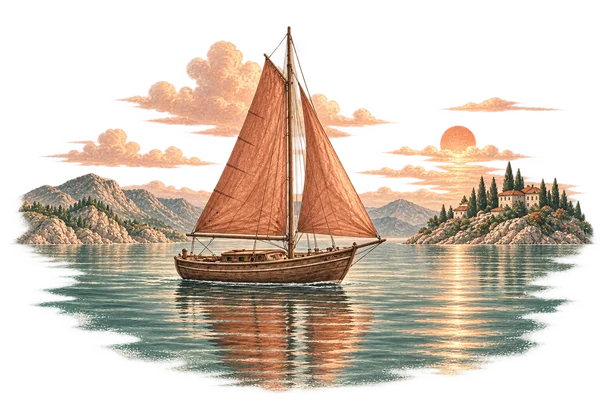
A boat can suggest shared support, limited resources, or navigating change. Steering, passengers, and water conditions shape the experience.
What this dream can mean
Support for uncertain conditions
The boat can picture the resources or arrangement that lets a change become manageable. Its suitability matters more than size alone: a modest vessel may be enough for the actual journey.
Steering or trusting someone else
Rowing, steering, and riding as a passenger create different forms of agency. The scene may concern self-directed effort, chosen reliance, or discomfort with a route decided for you.
The journey depends on shared balance
A crew can picture coordinated responsibility, while crowding or a leak may strain the arrangement. Cooperation changes how demanding conditions feel without making the water itself disappear.
Which version was yours?
You sail calmly with a cooperative crew
This can suggest a shared arrangement that distributes effort well. A team, household, or joint move may feel supported because people understand their roles. The comfort comes from both the vessel and the cooperation, rather than from calm water alone.
You row alone against the current
Progress depends on sustained effort under conditions that resist it. This may fit carrying a task without enough assistance or trying to move faster than circumstances allow. Choosing the route can still feel worthwhile, while fatigue makes the cost visible.
Too many people crowd a small boat
A shared resource may feel stretched beyond what it can comfortably support. Competing family needs or a project with more demands than capacity can offer parallels. Balance becomes difficult because everyone depends on the same limited arrangement.
Water enters while you repeatedly bail it out
This can picture managing consequences without reaching what keeps producing them. Recurrent expenses, interruptions, or unresolved tasks may consume the time intended for progress. Repairing the leak or sharing the work would change the scene from endless maintenance toward a workable response.
The boat remains anchored when you want to leave
A stabilizing arrangement can become restrictive when your needs change. Familiar routines, financial commitments, or other people's timing may keep you in place. The anchor can be protective or frustrating, depending on whether remaining there still serves your journey.
Another person steers while you sit beside them
The scene can explore chosen trust or dependence on a route you cannot direct. Shared travel, advice, or a decision managed by someone else may fit. Comfort suggests welcome support; unease can make the terms of that reliance more important.
A way to think about it
A boat can picture the arrangement that supports you while you move through uncertain conditions. Unlike a road, the water may not provide stable footing; the boat makes passage possible. A dependable vessel on calm water may fit having enough resources, cooperation, or structure for a change. A small boat need not feel inadequate if it suits the journey.
Steering and propulsion make agency concrete. Rowing alone may express self-directed effort, especially when every bit of progress depends on your work. Traveling as a passenger can instead suggest trusting another person's skill or feeling unable to influence the route. The difference is whether handing over control feels chosen and helpful or imposed.
A shared boat brings interdependence into view. Everyone's movement can affect the balance, and passengers may need to coordinate space or tasks. This can fit a household budget, collaborative work, or a transition whose consequences are shared. A crowded vessel may picture too many demands placed on one arrangement; a crew that shares the work can make the same journey feel manageable.
Water entering the boat can suggest that the boundary between the challenge and your support system is weakening. It may resemble demands consuming the resources meant to handle them. Bailing water while someone repairs the leak offers a different reading from endlessly removing it alone: one response reaches the source, while the other repeatedly manages the consequences.
Mooring or anchoring can represent a useful pause, or a difficulty leaving a familiar position. The desired destination and your willingness to move decide which fits. A real journey, boating memory, or image can also explain the scene without a symbolic reading.
Take a question into your day.
Save it before it slips away. No account needed.
STORIES & CONTEXTThe stories behind the symbol
The stories behind the symbol
Miller's Boat entry favors clear water and pleasant company while giving turbulent conditions adverse forecasts. Fontaine's 1862 Boat passage similarly contrasts enjoyable sailing with rough weather, though he says the predicted quarrels will be settled.
These historical claims map conditions onto fortune rather than establish a reliable dream code. Their useful distinction is between the vessel, the weather, and the company. The modern reading keeps those factors separate: a small boat can offer enough support, and rough water can be faced cooperatively rather than define the whole journey.
Compare the historical accounts
These are the authors’ historical interpretations. Their forecasts and period judgments are preserved as source material, not as predictions or established meanings for your dream.
Gustavus Hindman Miller
Ten Thousand Dreams Interpreted; Or, What’s in a Dream · Gutenberg #926; bibliography identifies the 1901 original and subsequent reprints
Boat · Heading 246; source lines 3837–3846 · Text transcription
Original source (English)
Boat signals forecast bright prospects, if upon clear water. If the water is unsettled and turbulent, cares and unhappy changes threaten the dreamer. If with a gay party you board a boat without an accident, many favors will be showered upon you. Unlucky the dreamer who falls overboard while sailing upon stormy waters.
Felix Fontaine
The Golden Wheel Dream-book and Fortune-teller · 1862
Boat · Heading 81; source line 1310 · Text transcription
Original source (English)
(See Oar, and Rudder.) To dream you are sailing in a boat in pleasant weather, and enjoying yourself, denotes good success in business; to lovers it foretells happiness; if the weather is boisterous, it predicts quarrels, which will be speedily settled; dreams of sailing smoothly in boats are emphatically good ones to all kinds of people.
To dream of being in a boat, Does show that maidens’ fancies float; And whether sink or swim they do, To try love’s sport their skill they’ll show.
A. H. Noe
The Witches' Dream Book; and Fortune Teller · New York, Henry J. Wehman, 1885
Boat · Dream section, heading 38; source lines 256–259 · Text transcription
Original source (English)
To dream that you are on the water in a boat, provided you are in company, denotes prosperity and success in your undertakings. If you dream you are in a boat alone, it is a bad omen. To dream the boat oversets, is the most fatal of all omens.
Astra Cielo
Fortunes and Dreams · New York, George Sully, 1917
Boat · Dream section, heading 66; source lines 4020–4023 · Text transcription
Original source (English)
To row in a canoe or boat signifies an inheritance of money.
Anonymous
Everybody’s Book of Luck · Whitman Publishing Company edition; date not stated in transcription
Boat · Dream section, heading 23; source lines 3567–3569 · Text transcription
Original source (English)
The arrival of a dear friend.
Sources for this page
- Understanding Sleep — general dream context, not a symbol interpretation
National Institute of Neurological Disorders and Stroke
General background: waking experiences and emotion can enter dreams; the function of dreaming is not settled. Does not test or validate this entry’s symbolic reflections.
Original DreamFolia editorial expansion with image-specific interpretations and six differentiated scenes. Historical context is attributed to actual source passages. Human publication review pending. Updated 2026-10-13. Read our approach and sources.