
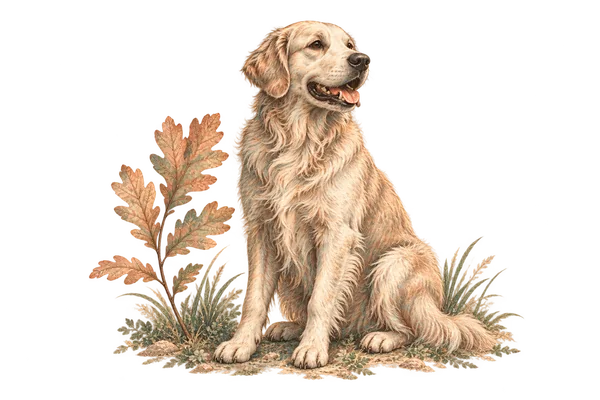
A dog may evoke companionship, care, or caution. Your history with dogs and the animal’s changing behavior help make the dream personal.
What this dream can mean
Companionship at your own pace
A dog walking, waiting, or playing alongside you may bring a particular bond to mind. Notice whether company feels freely chosen and whether you can both change pace without losing contact.
Signals, distance, and permission
An approach, a bark, and a guarded entrance ask different things of you. You might explore how you decide whether to move closer, pause, or make room, without turning the dog into evidence about someone else.
Care with help available
Feeding, sheltering, or searching for a dog can put responsibility at the center. Ask which tasks are actually yours in the scene and whether support is offered, requested, or unexpectedly absent.
Which version was yours?
Walking with a familiar dog
The animal keeps pace and the route feels comfortable. Notice whether companionship makes an ordinary journey different and what you do together. The scene may recall a real bond or invite reflection on company that leaves room for your own movement.
A dog growling at a doorway
You need to pass but cannot tell why the dog is guarding the entrance. Focus on the available routes and whether anyone helps interpret the situation. The dream can explore caution or access without establishing that a real person is hostile.
Searching for a missing dog
You follow sounds or ask others for help. The search may center on responsibility, attachment, or uncertainty about where to look next. Record what helps and how the scene ends without treating it as a forecast that an actual pet will disappear.
Several puppies needing attention
Each puppy pulls you toward a different task while another person watches. Notice how you decide what to do first and whether you can ask for practical help. The scene may invite reflection on divided attention without announcing future duties.
A frightened dog accepting some space
You stop reaching toward the animal and it settles nearby. Record what changes when you allow distance. This version can open a question about patience and signals; it does not require treating every hesitation as rejection.
A dog speaking in a familiar voice
The animal asks for something in words you recognize. Separate its exact request from what you think it represents. The surprising voice might recall an ordinary conversation, a playful story, or a need you want to describe more clearly.
A way to think about it
A dog can make companionship tangible through an ordinary shared activity. Walking at the same pace, waiting by a familiar chair or being greeted at a door may bring a particular bond into view. A remembered pet can remain that companion, while an unfamiliar dog may offer a comparison with company you are still getting to know. The useful connection comes from how the two of you share the scene, rather than a rule that every dog means loyalty.
Pace helps distinguish welcome company from a demand. A dog that stays beside you without pulling can resemble support that leaves you room to choose. One that repeatedly brings you a toy while you try to work creates a different question: an enjoyable relationship also needs attention. This could fit wanting to participate in something while struggling to make time for it. Irritation and affection need not cancel one another.
A growl at a doorway can make uncertainty about access concrete. You want to enter, but do not understand the signal that prevents it. Starting in an unfamiliar workplace, approaching a difficult conversation or joining a group with unclear expectations could offer parallels. A helper explaining another entrance changes the problem from confronting an opponent to finding a workable arrangement. The dream supplies no evidence that someone is secretly hostile.
Care gives the relationship another shape. Searching for a missing dog can center attachment and the wish to know where responsibility ends. Several puppies needing different things can resemble requests that are individually manageable but hard to coordinate together. Receiving help matters because the task no longer has to demonstrate one person's ability to handle everything. A dream cannot assess an actual pet's health or establish neglect.
Changes in behavior can be more informative than the first impression. A frightened dog settling when you stop reaching toward it may picture closeness becoming possible through more room. A familiar dog speaking with someone else's voice can connect affection with a request you recognize. Recent walks, films or practical concerns about an animal may also provide the encounter directly. These possibilities leave the dog a particular participant, with your own history and the ending giving the scene its personal direction.
Take a question into your day.
Save it before it slips away. No account needed.
STORIES & CONTEXTThe stories behind the symbol
The stories behind the symbol
Miller's Dogs entry supplies many forecasts according to behavior and appearance. Affection is linked with friends and gain, while aggression, barking, or poor condition are associated with enemies, quarrels, illness, and separation. Some passages make severe health claims; these remain Miller's period beliefs and have no role as diagnoses or warnings about a present dreamer. His Pup entry also links condition with friendship and fortune.
Fontaine (1862) and Noe (1885) contrast friendly dogs with snarling ones, while Cielo's Fortunes and Dreams (1917) associates a dog with faithfulness and a bite with treachery. Everybody's Book of Luck adds distinct forecasts for barking and fighting; Craig's The Fabric of Dreams (1918) collects fidelity and household associations. These books do not establish whether a real companion is trustworthy. Modern reflection can keep their attention to behavior while setting aside the claims about health, betrayal, marriage, and future events.
Compare the historical accounts
These are the authors’ historical interpretations. Their forecasts and period judgments are preserved as source material, not as predictions or established meanings for your dream.
Gustavus Hindman Miller · Dogs
Ten Thousand Dreams Interpreted; Or, What’s in a Dream · Gutenberg #926; bibliography identifies the 1901 original and subsequent reprints
Dogs · Heading 644; source lines 7668–7740 · Text transcription
Original source (English)
To dream of a vicious dog, denotes enemies and unalterable misfortune. To dream that a dog fondles you, indicates great gain and constant friends.
To dream of owning a dog with fine qualities, denotes that you will be possessed of solid wealth.
To dream that a blood-hound is tracking you, you are likely to fall into some temptation, in which there is much danger of your downfall.
To dream of small dogs, indicates that your thoughts and chief pleasures are of a frivolous order.
To dream of dogs biting you, foretells for you a quarrelsome companion either in marriage or business.
Lean, filthy dogs, indicate failure in business, also sickness among children.
To dream of a dog-show, is indicative of many and varied favors from fortune.
To hear the barking of dogs, foretells news of a depressing nature. Difficulties are more than likely to follow. To see dogs on the chase of foxes, and other large game, denotes an unusual briskness in all affairs.
To see fancy pet dogs, signifies a love of show, and that the owner is selfish and narrow. For a young woman, this dream foretells a fop for a sweetheart.
To feel much fright upon seeing a large mastiff, denotes that you will experience inconvenience because of efforts to rise above mediocrity. If a woman dreams this, she will marry a wise and humane man.
To hear the growling and snarling of dogs, indicates that you are at the mercy of designing people, and you will be afflicted with unpleasant home surroundings.
To hear the lonely baying of a dog, foretells a death or a long separation from friends.
To hear dogs growling and fighting, portends that you will be overcome by your enemies, and your life will be filled with depression.
To see dogs and cats seemingly on friendly terms, and suddenly turning on each other, showing their teeth and a general fight ensuing, you will meet with disaster in love and worldly pursuits, unless you succeed in quelling the row.
If you dream of a friendly white dog approaching you, it portends for you a victorious engagement whether in business or love. For a woman, this is an omen of an early marriage.
To dream of a many-headed dog, you are trying to maintain too many branches of business at one time. Success always comes with concentration of energies. A man who wishes to succeed in anything should be warned by this dream.
To dream of a mad dog, your most strenuous efforts will not bring desired results, and fatal disease may be clutching at your vitals. If a mad dog succeeds in biting you, it is a sign that you or some loved one is on the verge of insanity, and a deplorable tragedy may occur.
To dream of traveling alone, with a dog following you, foretells stanch friends and successful undertakings.
To dream of dogs swimming, indicates for you an easy stretch to happiness and fortune.
To dream that a dog kills a cat in your presence, is significant of profitable dealings and some unexpected pleasure.
For a dog to kill a snake in your presence, is an omen of good luck
Gustavus Hindman Miller · Pup
Ten Thousand Dreams Interpreted; Or, What’s in a Dream · Gutenberg #926; bibliography identifies the 1901 original and subsequent reprints
Pup · Heading 1636; source lines 18403–18413 · Text transcription
Original source (English)
To dream of pups, denotes that you will entertain the innocent and hapless, and thereby enjoy pleasure. The dream also shows that friendships will grow stronger, and fortune will increase if the pups are healthful and well formed, and vice versa if they are lean and filthy. See Dogs and Hound Pups.
The source heading “Pup” is shown on the Dogs page: dog core entry already aliases puppy
View source editionFelix Fontaine
The Golden Wheel Dream-book and Fortune-teller · 1862
Dogs · Heading 197; source line 1788 · Text transcription
Original source (English)
(See Mad Dog.) To dream of those animals, has very different significations; if they fawn and fondle upon you, it is a lucky omen; if you are in love, it portends marriage and happiness; but if they bark and snarl at you, it denotes that enemies are endeavoring to destroy your reputation and happiness; if in love, crosses.
A. H. Noe
The Witches' Dream Book; and Fortune Teller · New York, Henry J. Wehman, 1885
Dogs · Dream section, heading 134; source lines 601–607 · Text transcription
Original source (English)
To dream of these faithful and domestic animals has very different significations, according to the manner in which you see them. If they fawn and fondle upon you, then it is a very lucky omen. If you are in love, your sweetheart will marry you and be very happy. If they are barking and snarling at you, then depend that enemies are secretly endeavoring to destroy your reputation and happiness; if you are in love, be careful of your sweetheart.
Astra Cielo
Fortunes and Dreams · New York, George Sully, 1917
Dog · Dream section, heading 138; source lines 4185–4188 · Text transcription
Original source (English)
To see a dog indicates faithfulness of a friend. To be bitten means treachery.
Anonymous
Everybody’s Book of Luck · Whitman Publishing Company edition; date not stated in transcription
Dog · Dream section, heading 53; source lines 3639–3643 · Text transcription
Original source (English)
As a rule, a favorable sign; (Dog barking) somebody is trying to do you an ill turn; (Dogs fighting) serious quarrel between two friends of the dreamer.
Katherine Taylor Craig
The Fabric of Dreams: Dream Lore and Dream Interpretation, Ancient and Modern · New York, E. P. Dutton & Company, 1918; original US edition
Dog · Printed p. 212; NLM OCR lines 9765–9768 · OCR transcription
Original source (English)
A fortunate dream on the whole, denoting faithful friends (Gypsy). Modern symbol of fidelity, anciently held sacred to the Lares, i. e., the home.
Sources for this page
- Dreaming of a learning task is associated with enhanced sleep-dependent memory consolidation
Erin J. Wamsley and colleagues
Primary maze-learning experiment; task-related dream reports correlated with later performance. It does not show that a dream is an accurate memory or a solution.
Also indexed as: dog · puppy · puppies · pup
A little more to explore.
- Dog dreams: companionship, barking, bites, and finding a missing pet
Compare dog dream scenes through behavior, distance, care and personal memories, with an original example and questions for your notebook.
- How to reflect on a dream without forcing a meaning
Explore a dream through its details, feelings, and your own associations, with a worked example and questions that leave room for uncertainty.
- Children's dreams: listen to the story without deciding its meaning
Learn what children's dream reports can show, how to ask open questions, and how to respond to a frightening dream without imposing an interpretation.
Original reflection with AI-assisted editorial review on 2026-10-15, following the site owner’s continuing delegation of English editorial decisions. Historical accounts remain attributed period claims; the cited memory study does not validate these interpretations. Updated 2026-10-15. Read our approach and sources.