
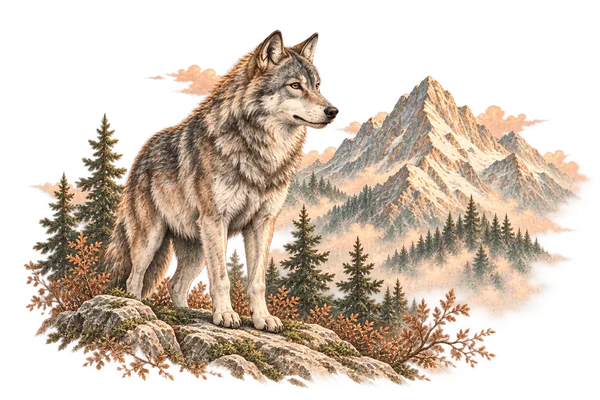
Wolf dreams can involve caution, companionship, or watching a group. Distance, behavior, and your own animal associations guide reflection.
What this dream can mean
Curiosity with a boundary
An unfamiliar wolf can hold interest and caution together. Approaching, waiting, or keeping a comfortable distance can each be a fitting response to something you do not yet know.
Your place near a group
A pack can make belonging tangible: there may be support, pressure to move together, or space you cannot enter. Your wish to join or leave gives the group its meaning.
Companionship and care
A calm or injured wolf can move the scene beyond threat. Connection may grow alongside uncertainty, and helping may raise a question about the limits that let you remain present.
Which version was yours?
A wolf watches from the edge of the woods
The encounter remains unresolved while each of you stays in place. It may fit cautious attention to a new person, role, or situation. Wanting to approach differs from wanting it to leave; either response gives the distance a purpose without establishing an actual threat.
You walk beside a calm wolf
Something initially unfamiliar becomes a companion. This can fit gaining confidence with a demanding task or finding support where you did not expect it. If others object while you feel safe, the scene may also place your own experience beside their assumptions.
You hear a howl but cannot see its source
The sound leaves you to imagine who or what is nearby. An answering howl can bring company into an empty landscape; silence afterward can sharpen isolation or uncertainty. Whether you answer, hide, or keep walking distinguishes a wish for connection from a need for distance.
A pack surrounds you
Their arrangement can feel protective or restrictive. Being allowed to move freely differs from having every exit blocked. A comparison with belonging may fit if group support currently comes with expectations; relief on leaving can matter as much as acceptance by the group.
A wolf pursues you and you find shelter
The repeated approach can give form to a concern that keeps returning despite attempts to avoid it. Shelter changes the scene by creating time or separation. If the wolf waits outside, temporary relief and an unfinished encounter remain present together.
You try to help an injured wolf
Concern draws you closer while uncertainty may hold you back. The scene can fit caring for someone or something without knowing how much help you can offer. Receiving assistance, being refused, or choosing to stay nearby creates different relationships between compassion and your own limits.
A way to think about it
A wolf can make the distance between familiarity and wildness feel important. It may look enough like a dog to invite closeness while remaining unfamiliar in the dream. A watchful animal at the edge of the woods can therefore hold curiosity and caution together: you want to understand what is there without knowing what an approach will ask of you. Someone accustomed to wolves may have a very different association, so the encounter matters more than an inherited story about danger.
When the wolf watches without attacking, the scene may give shape to being observed or evaluating a situation yourself. You could recognize the feeling of entering a group whose expectations are unclear, beginning a task before you know its demands, or waiting for someone else's response. The animal's stillness leaves room for anticipation. If it approaches gently and you relax, the movement may resemble discovering that an unfamiliar situation is more manageable than expected. If you remain comfortable at a distance, curiosity and a boundary can coexist.
A pack changes the encounter from one presence to a group. Being surrounded can feel like protection, pressure, or exclusion, depending on whether the wolves make room for you. This can fit a question about belonging: perhaps joining would offer support while also requiring you to move with others. Watching the pack leave may bring loneliness, freedom, or admiration rather than a single message about rejection. The important distinction is whether their togetherness is something you want, fear, or simply witness.
Walking beside a calm wolf can give companionship an unexpected form. A quality that first seemed intimidating becomes something you can share space with. This may resemble growing confidence in a demanding role, becoming comfortable with directness, or finding an ally outside a familiar circle. An injured wolf creates another tension: you may want to help while knowing that closeness feels uncertain. The dream can put care and limits in the same scene without requiring one to erase the other.
Pursuit brings the question back to movement and escape. A wolf that follows every turn can resemble a concern that stays present however you rearrange your day, while finding shelter can make relief the decisive moment. An unseen howl leaves more space for imagination: the sound may feel like a call, a warning, or company across a distance. Stories, games, wildlife programs, or memories of a pet can supply the image directly. None of these encounters identifies another person's loyalty or intentions; choose a comparison that fits the changing relationship between you and the animal.
Take a question into your day.
Save it before it slips away. No account needed.
STORIES & CONTEXTThe stories behind the symbol
The stories behind the symbol
Miller's Wolf entry treats the animal as a sign of an untrustworthy employee and its howl as a secret alliance against the dreamer. Fontaine's 1862 Wolf passage links pursuit with being cheated and adds warnings about a young woman's lover. These supplied texts document suspicion and moralizing advice in particular historical dictionaries; they do not reveal anyone's character through a dream.
That hostile framing has limited relevance to a scene about observation or companionship. It should not be used to convert an unfamiliar animal into an accusation against someone in waking life. This entry offers an original contextual comparison between distance, approach, and one's position near a group. Whether that comparison concerns caution, belonging, or curiosity depends on the scene and your experience. The old forecasts remain attributed period material, while the reflection leaves room for memories and associations that differ from the authors' assumptions.
Cielo adds a poverty forecast and makes an attack favorable to defeating enemies. Craig's supplied Wolf item is only a cross-reference to Lion, Fox and other entries; it supplies no independent Wolf interpretation. Preserving that limited record does not supply a missing argument or make neighboring animals interchangeable. Neither the forecasts nor the cross-reference can identify another person's intentions.
Compare the historical accounts
These are the authors’ historical interpretations. Their forecasts and period judgments are preserved as source material, not as predictions or established meanings for your dream.
Gustavus Hindman Miller
Ten Thousand Dreams Interpreted; Or, What’s in a Dream · Gutenberg #926; bibliography identifies the 1901 original and subsequent reprints
Wolf · Heading 2234; source lines 24527–24536 · Text transcription
Original source (English)
To dream of a wolf, shows that you have a thieving person in your employ, who will also betray secrets.
To kill one, denotes that you will defeat sly enemies who seek to overshadow you with disgrace. To hear the howl of a wolf, discovers to you a secret alliance to defeat you in honest competition.
Felix Fontaine
The Golden Wheel Dream-book and Fortune-teller · 1862
Wolf · Heading 871; source line 5290 · Text transcription
Original source (English)
To dream of being chased by one of these animals, foretells that you will be cheated in a trade or bargain: if a girl dreams of being frightened by a wolf, it shows that her lover (if she has one) is a bad man, and she had better discard him; if she has no lover, some black-hearted fellow will try to make her acquaintance.
Astra Cielo
Fortunes and Dreams · New York, George Sully, 1917
Wolf · Dream section, heading 471; source lines 5007–5010 · Text transcription
Original source (English)
To see a wolf is a sign of coming poverty. To be attacked by a wolf the defeat of your enemies.
Katherine Taylor Craig
The Fabric of Dreams: Dream Lore and Dream Interpretation, Ancient and Modern · New York, E. P. Dutton & Company, 1918; original US edition
Wolf · Printed p. 265; NLM OCR lines 12596–12597 · OCR transcription
Original source (English)
See Lion, Fox, etc.
Sources for this page
- Dreaming of a learning task is associated with enhanced sleep-dependent memory consolidation
Erin J. Wamsley and colleagues
Primary maze-learning experiment; task-related dream reports correlated with later performance. It does not show that a dream is an accurate memory or a solution.
Also indexed as: wolf
A little more to explore.
- Dreaming about being chased: follow the scene beyond the fear
Explore chase scenes through pursuers, escape, and your response, with worked reflection examples and questions for recording the experience.
- Dog dreams: companionship, barking, bites, and finding a missing pet
Compare dog dream scenes through behavior, distance, care and personal memories, with an original example and questions for your notebook.
Original reflection with AI-assisted editorial review on 2026-10-15, following the site owner’s continuing delegation of English editorial decisions. Historical accounts remain attributed period claims; the cited memory study does not validate these interpretations. Updated 2026-10-15. Read our approach and sources.