
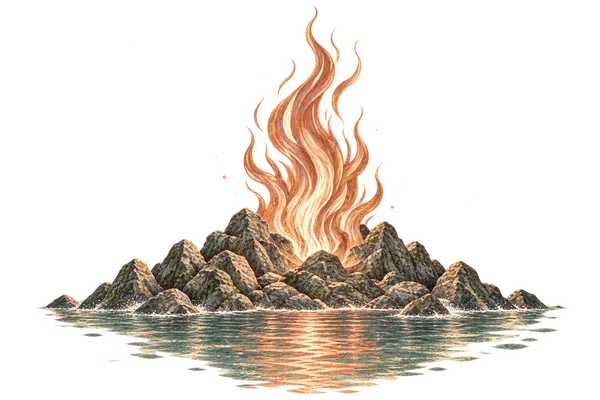
Fire dreams can hold warmth, urgency, or damage. What burns, who responds, and what survives help distinguish your experience.
What this dream can mean
Keeping something alive
A tended flame can picture the attention that sustains a home, relationship, or project. Whether the work feels shared, satisfying, or endless changes the reading.
Intensity exceeds its bounds
Fire that spreads beyond its proper place can resemble an emotion or demand that has begun directing everything around it. Where it starts and what feeds it make the comparison specific.
Choosing what survives
Rescue and deliberate burning both bring priorities into view. The ending can hold relief, grief, or ambivalence about what you protect and what you allow to change.
Which version was yours?
You keep feeding a hearth
A steady flame can make care feel tangible. If everyone expects warmth while you gather fuel alone, the scene may fit work that supports others without being shared. Enjoying the task or receiving help creates a different ending: care can become satisfying cooperation.
Fire spreads through a familiar building
The ordinary setting suddenly demands action. A conflict, deadline, or accumulated responsibility may offer a useful comparison if it has recently grown beyond its starting point. What blocks your exit and whether others respond can distinguish helplessness from an organized response.
You return to rescue a person or object
The choice gives the emergency a particular emotional center. A person, photograph, or tool may stand for a relationship, continuity, or the means to rebuild. Returning can feel purposeful or compulsory; discovering that the person is safe may release a responsibility you assumed was yours.
A small flame keeps going out
Repeated attempts to relight it can resemble trying to restore momentum or warmth when your usual effort no longer works. Frustration may make depleted resources central; relief when you stop can make it about permission to let an obligation end.
You return after the fire is over
The emergency gives way to discovering what remains. A usable room or recovered object can put continuity beside loss. Rebuilding may feel hopeful, exhausting, or unfair; the scene can explore living with an aftermath rather than needing to resolve the crisis again.
You deliberately burn something
The act makes an ending visible and difficult to reverse. It may fit wanting to release a role, reminder, or unfinished commitment. Relief and regret can coexist, especially if the object still mattered. The dream does not require destroying the corresponding possession in waking life.
A way to think about it
Fire can make the difference between enough and too much visible. A hearth warms a room because its heat has a place; a blaze takes over when it escapes that place. This can fit an emotion, ambition, or responsibility that feels useful while you can direct it and overwhelming when it begins deciding what happens next. The dream's question may be about how intensity is held, rather than whether intensity itself is good or bad.
Tending a flame can give shape to sustained care. Keeping a household comfortable, encouraging a relationship, or protecting time for a creative project all require attention that may go unnoticed when things run smoothly. If you constantly fetch wood while others relax, the scene may concern unequal effort. If someone takes over so you can rest, shared care becomes the important change. A dying fire can feel like a loss of energy, but it can also bring welcome permission to stop keeping something alive alone.
A spreading fire turns a concern into an immediate demand. You may recognize the pace of a disagreement that widened, a workload that acquired new tasks, or a decision delayed until several things became urgent together. Notice where the flames begin and what carries them onward. A small spark that suddenly fills the room makes escalation central; a distant blaze that never approaches can make anticipation, fascination, or helpless watching more important than personal danger.
What you save gives the dream a particular center. Rescuing photographs can put continuity and remembered relationships ahead of possessions. Returning for tools may emphasize the ability to start again. Looking for another person can bring care into conflict with your own need to leave. These are possible connections within the scene, not fixed meanings for those objects. Finding that someone is already safe can shift the ending from frantic responsibility toward relief, while escaping without everything can leave grief alongside survival. Afterward, blackened walls beside usable furniture can hold damage and continuity together. Rebuilding may feel hopeful or unfair if you must repair a crisis you did not create.
Fire can also feel cleansing, beautiful, or intimate. Burning something deliberately may resemble ending a commitment or making a change irreversible; regret afterward may show what remains valuable in the thing you wished to leave. Sitting beside a contained flame can simply offer comfort and companionship. Recent cooking, a fire drill, a film, or a remembered campfire may supply the image directly. A dreamed blaze does not predict a real fire or require a drastic decision. The useful reading explains the movement between warmth, urgency, loss, and relief in your particular encounter.
Take a question into your day.
Save it before it slips away. No account needed.
STORIES & CONTEXTThe stories behind the symbol
The stories behind the symbol
Gustavus Hindman Miller's Fire entry in Ten Thousand Dreams Interpreted links an uninjured dreamer and even a burning home or store with prosperity and domestic satisfaction. His Flame passage instead emphasizes the effort of accumulating wealth. These are particular claims in an early twentieth-century dream dictionary, not a general tradition that establishes fire as fortunate. The supplied records preserve his business and household concerns alongside the imagery.
Astra Cielo's 1917 Fortunes and Dreams gives a burning house a cautionary reading and associates kindling with anger. Comparing these actual passages shows disagreement rather than a consistent code. An original contextual question can retain their attention to setting: when does fire sustain an activity, and when does it interrupt it? Your own experiences with cooking, light, shelter, or danger give that question substance. Neither author supplies evidence that your dream predicts profit, betrayal, or a real fire.
The other attached books widen the disagreement. Noe and the 1894 Guide include severe accident and health forecasts; the 1805 passages associate house fire with anger and a great fire with illness or discontent. Cielo's separate Flame item gives good news, while Craig's Flames item gives happiness and an attributed Christian association. These are the supplied authors' claims, not present-day warnings or a verified shared tradition.
Compare the historical accounts
These are the authors’ historical interpretations. Their forecasts and period judgments are preserved as source material, not as predictions or established meanings for your dream.
Gustavus Hindman Miller · Fire
Ten Thousand Dreams Interpreted; Or, What’s in a Dream · Gutenberg #926; bibliography identifies the 1901 original and subsequent reprints
Fire · Heading 789; source lines 9236–9262 · Text transcription
Original source (English)
Fire is favorable to the dreamer if he does not get burned. It brings continued prosperity to seamen and voyagers, as well as to those on land.
To dream of seeing your home burning, denotes a loving companion, obedient children, and careful servants.
For a business man to dream that his store is burning, and he is looking on, foretells a great rush in business and profitable results.
To dream that he is fighting fire and does not get burned, denotes that he will be much worked and worried as to the conduct of his business. To see the ruins of his store after a fire, forebodes ill luck. He will be almost ready to give up the effort of amassing a handsome fortune and a brilliant business record as useless, but some unforeseen good fortune will bear him up again.
If you dream of kindling a fire, you may expect many pleasant surprises. You will have distant friends to visit.
To see a large conflagration, denotes to sailors a profitable and safe voyage. To men of literary affairs, advancement and honors; to business people, unlimited success.
Gustavus Hindman Miller · Flame
Ten Thousand Dreams Interpreted; Or, What’s in a Dream · Gutenberg #926; bibliography identifies the 1901 original and subsequent reprints
Flame · Heading 804; source lines 9386–9394 · Text transcription
Original source (English)
To dream of fighting flames, foretells that you will have to put forth your best efforts and energy if you are successful in amassing wealth. See Fire.
The source heading “Flame” is shown on the Fire page: fire core entry already aliases flame
View source editionFelix Fontaine
The Golden Wheel Dream-book and Fortune-teller · 1862
Fire · Heading 261; source line 2092 · Text transcription
Original source (English)
(See Burning.) If in your dream, you see a house on fire other than your own, it foretells that some event will happen to make you melancholy and sorrowful, such as the death or ruin of some esteemed friend. If you dream your own house or place of business is burning, it is an omen of good fortune. If you dream of playing with fire, it is a sign of a quarrel in bed. For this dream play your age first. 26.
To dream of sitting by the fire, When it is late, doth show desire; But if you sit till the fire’s out, Your love will prove false out of doubt.
A. H. Noe
The Witches' Dream Book; and Fortune Teller · New York, Henry J. Wehman, 1885
Fire · Dream section, heading 185; source lines 786–797 · Text transcription
Original source (English)
To dream of this subtle element, denotes health and happiness to the lover, marriage to the object of his affections and many children. It also denotes that you will be very angry with some one on a trifling occasion. To dream you see burning lights descending as it were from heaven, is a very bad sign indeed. It portends some dreadful accident to the dreamer, such as being hanged, losing your head, having your brains dashed out, breaking your legs, getting into prison, or other strange accidents. To the lover, it also denotes the loss of the affections of your sweetheart. To the tradesman, bad success in business. To dream that you are burnt by fire, denotes great danger, and that enemies will injure you. To the sailor, storms and shipwreck.
Astra Cielo · Fire
Fortunes and Dreams · New York, George Sully, 1917
Fire · Dream section, heading 170; source lines 4260–4263 · Text transcription
Original source (English)
To see a house on fire is a sign of caution. Beware of false friends. To kindle a fire denotes anger.
Astra Cielo · Flame
Fortunes and Dreams · New York, George Sully, 1917
Flame · Dream section, heading 173; source lines 4269–4271 · Text transcription
Original source (English)
To see a flame is a sign of good news.
The source heading “Flame” is shown on the Fire page: fire core entry already aliases flame
View source editionAnonymous
Guide to Fortune-Telling by Dreams · Multum in Parvo Library, Vol. I, No. 10, October 1894
Fire · Dream section, heading 26; source lines 251–262 · Text transcription
Original source (English)
To dream of this subtle element denotes health and happiness to the lover, marriage with the object of your affections, and many children; you will be very angry with some one on a trifling occasion. Burning lights descending, as it were from heaven, are a very bad sign; it portends some dreadful accident--having your brains dashed out, breaking your legs, getting into prison, or other strange accidents; to the lover it also denotes the loss of the affections of your sweetheart; to the tradesman bad fortune in business. To dream that you are burnt by fire denotes great danger, and that enemies will injure you.
Anonymous · Fire
The Interpretation of Dreams and Moles · United Kingdom, J. Marshall, 1805
Fire · Dreams interpreted, passage 45; source lines 241–241 · Text transcription
Original source heading: (no printed heading)
Original source (English)
To dream of a house on fire means anger.
The 1805 text prints this passage without a heading; DreamFolia files it under “Fire” because that is the subject of its first clause.
View source editionAnonymous · Fire
The Interpretation of Dreams and Moles · United Kingdom, J. Marshall, 1805
Fire · Dreams interpreted, passage 56; source lines 274–275 · Text transcription
Original source heading: (no printed heading)
Original source (English)
To dream of a great fire, signifies sickness, or discontent with the person’s lot.
The 1805 text prints this passage without a heading; DreamFolia files it under “Fire” because that is the subject of its first clause.
View source editionKatherine Taylor Craig
The Fabric of Dreams: Dream Lore and Dream Interpretation, Ancient and Modern · New York, E. P. Dutton & Company, 1918; original US edition
Flames · Printed p. 217; NLM OCR lines 10007–10009 · OCR transcription
Original source (English)
To dream of flames denotes happiness (Gypsy). Flames, a Christian symbol of zeal, fervor.
The source heading “Flame” is shown on the Fire page: fire core entry already aliases flame
View source editionSources for this page
- Dreaming of a learning task is associated with enhanced sleep-dependent memory consolidation
Erin J. Wamsley and colleagues
Primary maze-learning experiment; task-related dream reports correlated with later performance. It does not show that a dream is an accurate memory or a solution.
Also indexed as: flame · flames · burning
A little more to explore.
- Fire dreams: warmth, spreading flames, escape, and what remains
Explore fire dream scenes through control, distance, help and aftermath, with contrasting examples and room for personal associations.
Original reflection with AI-assisted editorial review on 2026-10-15, following the site owner’s continuing delegation of English editorial decisions. Historical accounts remain attributed period claims; the cited memory study does not validate these interpretations. Updated 2026-10-15. Read our approach and sources.