
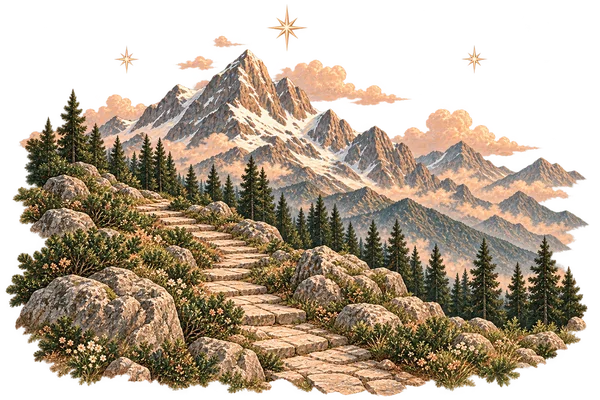
A mountain can suggest a demanding goal, a change in scale, or a wish for perspective. Reaching the summit is only one possible meaningful ending.
What this dream can mean
A goal large enough to shape the journey
The mountain can picture a demanding task whose result is visible before the route is clear. Its scale makes preparation and sustained effort more important than desire alone.
The cost of the chosen pace
Exhaustion or difficult ground may suggest a mismatch between demands and resources. Changing pace or route can respond to conditions without necessarily abandoning a goal that matters.
Achievement, perspective, and return
A summit may express satisfaction or expose an unmet expectation. Descending can bring an accomplishment into daily life, while viewing the mountain may offer perspective without an obligation to climb.
Which version was yours?
You admire the mountain from a distance
The scene can offer scale and perspective without requiring achievement. A demanding situation may become easier to place within a wider view. Wonder or peace makes the mountain something to appreciate, rather than an assignment you must complete.
A clear path makes the climb manageable
This can picture having preparation and support suited to a substantial goal. A well-organized project or learning process may fit. The climb still requires effort, but knowing the route allows that effort to feel purposeful rather than consumed by uncertainty.
The ground becomes steeper than you expected
A goal may involve costs that were not visible at the start. Expanding responsibilities, limited support, or an unsuitable pace can offer parallels. The difficult terrain makes reconsidering conditions relevant, rather than declaring that you lack determination.
The summit feels empty after you reach it
A completed milestone may not provide the recognition, connection, or relief you hoped for. Finishing a qualification or project can feel similar when expectations and actual needs diverge. The achievement remains real, while its meaning may require reassessment.
You descend safely after deciding to turn back
This can suggest choosing a workable limit or revising a route with better knowledge of the conditions. Leaving a demanding plan may feel disappointing and sensible at once. The safe return centers responsibility for yourself, rather than an automatic story of failure.
Your group crosses a pass instead of climbing the peak
A shared journey may be directed toward what lies beyond the mountain, not toward proving you can reach its highest point. A transition with practical goals can fit. Cooperation and choosing an appropriate route matter more than individual conquest.
A way to think about it
A mountain can picture a goal that feels substantial enough to organize your attention. From below, its size makes the distance between wanting and reaching visible. A qualification, long project, or major move may feel similar: the result is imaginable, but the route requires sustained effort. Admiring a mountain without climbing can instead express wonder or perspective rather than a demand to achieve something.
The ascent can give form to how that effort is unfolding. A manageable path may fit clear preparation and support. Rugged ground or increasing exhaustion may suggest that the cost is greater than you expected, or that the chosen pace does not suit your resources. This does not make ambition wrong; it brings the conditions of pursuing it into view.
A summit can center recognition and the hoped-for result. Relief or satisfaction may fit completing something meaningful, while an empty or disappointing summit can picture achieving an expected milestone without receiving what you actually needed. A new goal immediately appearing beyond it may express pressure to keep proving yourself.
Turning back or descending can have a purposeful reading. Leaving an unsuitable route may picture revising priorities, and a safe descent may suggest bringing an achievement back into ordinary life. Knowing how to return can be part of completing the journey, not a reversal of its value.
Traveling with others introduces shared pace, differing goals, and mutual support. Crossing a pass rather than climbing a peak may suggest a practical transition whose purpose lies beyond the mountain. Real landscapes, outdoor experiences, and remembered images can also supply the scene directly; no ending needs to serve as a verdict on your ability.
Take a question into your day.
Save it before it slips away. No account needed.
STORIES & CONTEXTThe stories behind the symbol
The stories behind the symbol
Miller, Fontaine and Noe tie pleasant terrain or successful ascent to advancement, wealth and gendered relationship forecasts; difficult ground receives adverse readings. Craig reports fear and trouble under an Artemidorus attribution, then quotes the literary story of Kremhild warning Siegfried after dreaming of falling mountains. A narrative example is not evidence that dreams foretell death. None of these period claims establishes character, fortune or danger. The original reflection gives viewing, crossing a pass, reaching a summit and returning safely their own purposes.
Compare the historical accounts
These are the authors’ historical interpretations. Their forecasts and period judgments are preserved as source material, not as predictions or established meanings for your dream.
Gustavus Hindman Miller
Ten Thousand Dreams Interpreted; Or, What’s in a Dream · Gutenberg #926; bibliography identifies the 1901 original and subsequent reprints
Mountain · Heading 1346; source lines 15444–15462 · Text transcription
Original source (English)
For a young woman to dream of crossing a mountain in company with her cousin and dead brother, who was smiling, denotes she will have a distinctive change in her life for the better, but there are warnings against allurements and deceitfulness of friends. If she becomes exhausted and refuses to go further, she will be slightly disappointed in not gaining quite so exalted a position as was hoped for by her.
If you ascend a mountain in your dreams, and the way is pleasant and verdant, you will rise swiftly to wealth and prominence. If the mountain is rugged, and you fail to reach the top, you may expect reverses in your life, and should strive to overcome all weakness in your nature. To awaken when you are at a dangerous point in ascending, denotes that you will find affairs taking a flattering turn when they appear gloomy.
Felix Fontaine
The Golden Wheel Dream-book and Fortune-teller · 1862
Mountain · Heading 482; source line 3240 · Text transcription
Original source (English)
To dream of approaching beautiful smooth-looking mountains, dressed in verdure, denotes thrift and happiness, and that you will rise in the world: if the mountains look steep, rugged and rocky, it foreshadows difficulties and danger, which you may overcome by energy: to dream of successfully climbing a mountain, is a sure sign that some honor awaits you, or that you will make a good deal of money: difficulties in climbing show troubles and vexations in getting your honors or your money.
A. H. Noe
The Witches' Dream Book; and Fortune Teller · New York, Henry J. Wehman, 1885
Mountains · Dream section, heading 332; source lines 1312–1317 · Text transcription
Original source (English)
To dream you see steep and craggy mountains, presages difficulties in accomplishing your designs. If you ascend them and gain the top, you will be successful in whatever you undertake, become very rich, and arrive at great honors in the state. To a maid, they denote that she will marry a man who will become rich and powerful, and that her children will be people of consequence.
Katherine Taylor Craig
The Fabric of Dreams: Dream Lore and Dream Interpretation, Ancient and Modern · New York, E. P. Dutton & Company, 1918; original US edition
Mountains · Printed p. 235; NLM OCR lines 10956–10965 · OCR transcription
Original source (English)
A dream of heaviness, fear and trouble (Artemidorus). Thus Kremhild warns her lord Siegfried of his approaching death. "Nay, Siegfried, I fear some mischance. Last night I dreamed an evil dream; how that two mountains fell on thee and I saw thee no more. If thou goest thou wilt grieve me bitterly." Nevertheless he rode off. She never saw him alive again. — Fall of the Niehelungs.
Sources for this page
- Understanding Sleep — general dream context, not a symbol interpretation
National Institute of Neurological Disorders and Stroke
General background: waking experiences and emotion can enter dreams; the function of dreaming is not settled. Does not test or validate this entry’s symbolic reflections.
Also indexed as: mountains
Original reflection with AI-assisted editorial review on 2026-10-15, following the site owner’s continuing English editorial delegation. Historical accounts retain their attribution; general sleep background does not validate these interpretations. Updated 2026-10-15. Read our approach and sources.