
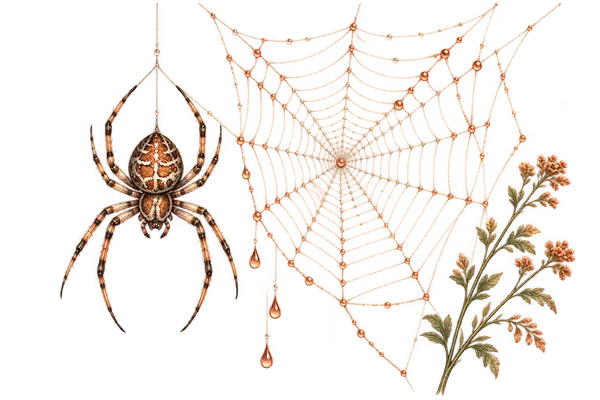
Spiders can explore proximity, observing work in progress, and the terms of making room for a living creature alongside your own task.
What this dream can mean
Proximity changes the practical need
A creature on a shared surface differs from one inside clothing; the needed boundary depends on the actual location.
Another participant’s work has a place
Appreciating a developing structure can coexist with negotiating its position within a space you also use.
A particular restriction can be changed
Strands, scale and distance can create separate problems rather than one global image of being trapped.
Which version was yours?
A spider crosses the table where you are working
A small visitor changes how the surface can be used. This may picture an interruption with practical needs of its own. Waiting or moving an object can support both routes without requiring every unexpected presence to be treated as an obstacle or a threat.
A spider is inside your cuff where you cannot see it clearly
Closeness arrives without a clear view of the encounter. This can resemble wanting a boundary restored before continuing a task. Making room and gaining visibility are particular needs; the image does not diagnose contamination, danger or your response to intimacy.
You watch a spider build across part of a shared room
Another participant’s developing work affects a space you also use. This may picture admiring a contribution while needing its placement discussed. Respect for the activity does not require leaving every surrounding condition unchanged or assigning the creature a work ethic.
One sleeve catches in strands while the rest of the route is open
A limited restriction interrupts an available action. This can resemble one part of an arrangement needing revision. Carefully changing that connection may be enough, without treating the entire relationship or task as a trap or inferring someone’s intention to control you.
A giant spider remains at a comfortable distance
Scale and approach no longer supply the same account of the encounter. This may picture an impressive concern becoming manageable through a clear boundary. The changed feeling belongs to this scene; size does not establish danger or an actual person’s power over you.
You protect a spider while moving the web from a doorway
Care and access require different adjustments. This can resemble preserving a contribution while changing where it belongs. A workable arrangement may support both purposes without making all relocation harmful or every existing structure something that must remain untouched.
A way to think about it
A spider crossing a table while you work can make a small moving presence change the use of an ordinary surface. You may want to finish your task and also allow the visitor a route. A brief interruption or another person’s practical need can have a similar shape. Waiting, moving an object or relocating the spider can each express a different arrangement without revealing a fixed attitude toward control.
A spider inside a cuff brings the encounter close to the body. The difficulty may concern being unable to see clearly while wanting distance restored. An unexpected closeness in a conversation or an obligation carried into private time can offer parallels. That comparison remains optional; a dream spider does not establish contamination, an actual threat or a medical condition.
Watching a spider build can make another participant’s work visible without requiring you to direct it. You may admire the developing structure while noticing that its position affects your own use of the room. A shared workspace may need the same distinction between valuing a contribution and accepting every placement. Moving a necessary object can interrupt the construction, making care and practical change pull in different directions.
Becoming caught in strands changes observation into restricted movement. The useful question may concern which part prevents the action you want: one sleeve, a doorway or the whole route. A particular disentangling task can resemble revising a complicated arrangement without deciding that all your connections form a trap. The spider’s actual presence and behavior remain separate details.
A giant spider keeping its distance can instead challenge an expectation that size must imply approach. Your initial fear may change when the encounter offers a clear boundary. Protecting a spider while reluctantly moving its web makes preservation and access distinct choices again. Recent housekeeping, images or actual encounters may supply the scene directly. These original readings center an active creature and its relation to the setting. An abandoned, dusty cobweb and a web with no visible animal have their own subjects; no universal manipulation or personality code is required.
Take a question into your day.
Save it before it slips away. No account needed.
STORIES & CONTEXTThe stories behind the symbol
The stories behind the symbol
Miller’s two distinct records concern Spider and Spider-web. Fontaine, Cielo and Everybody’s Book of Luck give money, work and other forecasts; Fontaine also makes an unsupported miscarriage claim. Craig reports named fortune/character associations and a headache theory. These six historical records validate no prediction, personality code or diagnosis; The cited learning experiment provides memory-research context only, not evidence for spider meanings.
Compare the historical accounts
These are the authors’ historical interpretations. Their forecasts and period judgments are preserved as source material, not as predictions or established meanings for your dream.
Gustavus Hindman Miller · Spider
Ten Thousand Dreams Interpreted; Or, What’s in a Dream · Gutenberg #926; bibliography identifies the 1901 original and subsequent reprints
Spider · Heading 1891; source lines 20981–21015 · Text transcription
Original source (English)
To dream of a spider, denotes that you will be careful and energetic in your labors, and fortune will be amassed to pleasing proportions.
To see one building its web, foretells that you will be happy and secure in your own home.
To kill one, signifies quarrels with your wife or sweetheart.
If one bites you, you will be the victim of unfaithfulness and will suffer from enemies in your business.
If you dream that you see many spiders hanging in their webs around you, foretells most favorable conditions, fortune, good health and friends.
To dream of a large spider confronting you, signifies that your elevation to fortune will be swift, unless you are in dangerous contact.
To dream that you see a very large spider and a small one coming towards you, denotes that you will be prosperous, and that you will feel for a time that you are immensely successful; but if the large one bites you, enemies will steal away your good fortune. If the little one bites you, you will be harassed with little spites and jealousies. To imagine that you are running from a large spider, denotes you will lose fortune in slighting opportunities. If you kill the spider you will eventually come into fair estate. If it afterwards returns to life and pursues you, you will be oppressed by sickness and wavering fortunes.
For a young woman to dream she sees gold spiders crawling around her, foretells that her fortune and prospect for happiness will improve, and new friends will surround her.
Gustavus Hindman Miller · Spider-web
Ten Thousand Dreams Interpreted; Or, What’s in a Dream · Gutenberg #926; bibliography identifies the 1901 original and subsequent reprints
Spider-web · Heading 1892; source lines 21015–21019 · Text transcription
Original source (English)
To see spider-webs, denotes pleasant associations and fortunate ventures.
The source heading “Spider-web” is shown on the Spiders page: spider core entry already aliases web/cobweb
View source editionFelix Fontaine
The Golden Wheel Dream-book and Fortune-teller · 1862
Spider · Heading 746; source line 4636 · Text transcription
Original source (English)
To dream that you see a spider coming toward you, is a sign that some one will soon pay you money: if you imagine that the spider spins down before your face, the omen is similar, for you will make a good lot of money in some way. If a married woman dreams of seeing a large spider, it foretells that she will have a miscarriage, which she will not be sorry for.
Astra Cielo
Fortunes and Dreams · New York, George Sully, 1917
Spider · Dream section, heading 397; source lines 4821–4824 · Text transcription
Original source (English)
To see a spider spinning its web denotes success in business.
Anonymous
Everybody’s Book of Luck · Whitman Publishing Company edition; date not stated in transcription
Spider · Dream section, heading 226; source lines 4106–4108 · Text transcription
Original source (English)
Good luck, successful schemes: (killing one) a very bad omen.
Katherine Taylor Craig
The Fabric of Dreams: Dream Lore and Dream Interpretation, Ancient and Modern · New York, E. P. Dutton & Company, 1918; original US edition
Spiders · Printed p. 254–255; NLM OCR lines 11995–12009 · OCR transcription
Original source (English)
To dream of a spider foretells money; for a spider to spin its web before your face augurs a fortune (Raphael). The spider is the symbol of shrewdness, perseverance and foresight (Pavitt). Schemer holds that to dream of seeing the upper part of a room covered with spiders is a symptom of headache.
Sources for this page
- Dreaming of a learning task is associated with enhanced sleep-dependent memory consolidation
Erin J. Wamsley and colleagues
Primary maze-learning experiment; task-related dream reports correlated with later performance. It does not show that a dream is an accurate memory or a solution.
Also indexed as: spider · web · spider-web
A little more to explore.
- Spider dreams: webs, distance, many small spiders, and close observation
Compare spider dream scenes, from a web across a doorway to calm observation, with original examples that keep fear, curiosity and context distinct.
Original reflection with AI-assisted editorial review on 2026-10-15, following the site owner’s continuing delegation of English editorial decisions. Historical accounts remain attributed period claims; the cited memory study does not validate these interpretations. Updated 2026-10-15. Read our approach and sources.